Category: Buying Guides

  • How Many Custom Beer Steins Should You Order? A Quantity Planning Guide

    How Many Custom Beer Steins Should You Order? A Quantity Planning Guide

    Published October 1, 2026. Last updated October 1, 2026.

    Most custom beer stein orders should be sized at the number of recipients plus 10 to 15 percent spares, rounded up to a full case, with a minimum of 12 steins per design at Custom Beer Stein. That buffer covers late additions, breakage in transit and display pieces, and it keeps every stein in the run identical because it is produced together.

    Key facts
    • Minimum order is 12 custom beer steins per design
    • Plan 10 to 15 percent spares on top of the headcount
    • Standard turnaround is about 2 weeks after proof approval, with faster options available
    • A free mockup arrives within 24 hours of sending your artwork

    What is the simplest formula for a custom beer stein order?

    Start with the number of people who will actually receive a custom beer stein, not the number invited. For a wedding that is the guest list after RSVPs, for a taproom it is the mug club cap, and for a corporate gift it is the recipient list plus leadership. Add 10 to 15 percent as spares, then round up to the next multiple of six so the order packs into full cases.

    Written out, the formula is recipients x 1.1 to 1.15, rounded up to a case. A 60-guest wedding becomes 66 to 69 steins, which rounds to 72. A 40-member mug club becomes 44 to 46, which rounds to 48. Custom Beer Stein produces each design as one run, so ordering the spares now means they match the originals exactly in glaze, engraving depth and color.

    Why do spares matter more for steins than for other custom items?

    A custom beer stein is a fired ceramic or heavy glass piece, and every batch carries a small chance of a chip in shipping or a hairline crack that only shows up on first use. Spares also absorb the people who appear at the last minute: the plus-one who confirms the week before, the new hire who joins the team two days before the gift hand-out, the member who renews after the roster closed.

    • Weddings and parties: keep 6 to 8 spares per 60 guests for late RSVPs and the head table display.
    • Taprooms and mug clubs: keep one full case in reserve for replacements, since members expect a matching stein when one breaks.
    • Corporate and award programs: keep 3 to 5 spares for recipients added after the list is approved and for a showroom sample.

    Reordering a handful of steins later is possible, but a second run is a second production slot with its own two-week schedule, and ceramic glazes can vary slightly between kilns. Ordering the buffer up front avoids both problems.

    How should a wedding or private party size the order?

    Decide first whether every guest gets a custom beer stein or only a defined group. Full-guest favors mean the stein doubles as the drinking vessel for the evening, so count every adult on the final RSVP list and add 10 percent. Wedding-party-only orders are smaller and usually carry individual names, which still fit inside the 12-stein minimum when you include both families and the couple.

    Think about who needs a stein that is not a guest: the officiant, the photographer who gets a thank-you, and two or three display pieces for the bar or the gift table. Those extras are easy to forget and are the usual reason a couple ends up two steins short on the day. Custom Beer Stein can mix a shared crest design with personalized names on the same run, which is a practical way to cover the whole room without ordering two separate designs. The wedding stein page walks through the engraving options for that mix.

    How do taprooms and mug clubs plan an ongoing program?

    A taproom program is an inventory question rather than a one-time count. Set the membership cap first, then order the cap plus a reserve case so every member who signs up during the season receives the same stein. If the club renews yearly with a new design, order to the expected renewal number plus the growth you can realistically sell in the first month, because a stein that sits in storage for eleven months is cash tied up on a shelf.

    Many breweries stage the program in two runs: an opening run sized to the founding members plus 20 percent, and a second run ordered the moment sign-ups pass 70 percent of stock. Because the second run lands about two weeks after approval, that trigger point keeps the bar from ever running out. The glass stein page and the ceramic stein page explain which style survives a dishwasher-heavy bar shift better.

    What quantity makes sense for corporate gifts and awards?

    For an employee or client gift, the headcount is fixed, so the real decision is how many extra steins to hold for additions and for the people who present the gift. A rule that works for most companies is the recipient list plus five percent, with a floor of three spares, rounded up to a case. For a milestone award program that runs all year, order the expected number of honorees for the year in one run so every award matches, rather than ordering one or two at a time.

    Gift sets change the math slightly. If the stein ships in a presentation box with a card, order boxes and inserts in the same quantity as the steins and confirm the box dimensions against the stein size before production. The gift set page lists the packaging options that pair with each stein style.

    How does the quantity affect timing and the mockup step?

    Quantity does not change the proof process: you send artwork, Custom Beer Stein returns a free mockup within 24 hours, and production starts only after you approve it. What quantity does change is the production window. Standard turnaround is about two weeks after approval for typical runs, and faster turnaround is available with express shipping when an event date is close. Very large runs, in the several hundreds, benefit from approving the proof a week earlier so the kiln and engraving schedule can be reserved.

    1. Lock the recipient count and add the spare buffer.
    2. Send artwork and get the free mockup within 24 hours.
    3. Approve the proof, which starts the roughly two-week production clock.
    4. Receive the full run, including spares, in one shipment.

    If the headcount is still moving, approve the design now and confirm the final quantity before production begins. That keeps the schedule while leaving room for late changes to the number.

    What are the most common sizing mistakes?

    The first mistake is counting invitations instead of confirmed attendees, which inflates the order and the budget. The second is the opposite: ordering exactly the headcount with no spares and then needing a second run for three steins. The third is splitting one event into two small designs that each fall below the 12-stein minimum, when a shared crest with personalized names would have covered everyone in one run.

    Less obvious mistakes include ordering a different size for spares, forgetting display and presenter pieces, and leaving the final count open so late that the proof approval slips past the two-week window. A quick call or a note on the quote form with the event date lets Custom Beer Stein flag any of those before the order is placed.

    Frequently asked questions

    How many spare custom beer steins should I add to my order?

    Add 10 to 15 percent spares on top of the number of recipients, with a floor of three extra steins, then round up to a full case. Spares cover late additions, transit breakage and display pieces, and because they are produced in the same run they match the rest of the order exactly.

    Can I order fewer than 12 custom beer steins for a small wedding party?

    The minimum run at Custom Beer Stein is 12 steins per design, which usually covers a wedding party once both families and the couple are included. If your group is smaller, the remaining steins make useful spares or keepsakes for parents and the officiant, and personalized names can vary within the same run.

    Should I count children or non-drinkers when sizing a stein order for an event?

    Count only the adults who will receive a custom beer stein, and decide separately whether non-drinking guests get one as a keepsake. Many hosts include every adult because the stein works as a favor regardless of what goes in it, while children are usually left out of the count entirely.

    How many custom beer steins does a taproom need to launch a mug club?

    Order the membership cap plus one reserve case. A club capped at 48 members should start with 54 to 60 steins so late sign-ups and the occasional replacement are covered without a second production run. Trigger a reorder when sign-ups reach about 70 percent of the stock on hand.

    Is it better to order custom beer steins in one large run or several small runs?

    One run is better whenever the headcount is known, because every stein is fired, glazed and engraved together and matches exactly. Several small runs each carry their own two-week schedule and a small chance of glaze variation between batches. Stage multiple runs only for ongoing programs such as a club that grows through the season.

    What happens if I need more custom beer steins after the first order arrives?

    You can reorder the same design from the saved artwork, and Custom Beer Stein keeps the proof on file so the setup is quick. The second run still needs the standard production window of about two weeks after approval, so a reorder should be placed as soon as the shortfall is known.

    How far ahead of an event should I place a custom beer stein order for 100 guests?

    Aim to approve the mockup at least four weeks before the event. That leaves the roughly two-week production window, shipping time and a margin for a last count change. The free mockup arrives within 24 hours of sending artwork, so the earlier you send the design, the more of that buffer stays intact.

    Do I need the final headcount before Custom Beer Stein starts the mockup?

    No. The mockup is about the design, not the quantity, so you can approve the artwork while RSVPs are still arriving. The final quantity must be confirmed before production begins, because the run is sized and scheduled at that point. Many couples approve the design early and confirm the count a week later.

    Can one order of custom beer steins mix personalized names with a shared crest design?

    Yes. A single run can carry a shared crest or logo on every stein while the name changes from piece to piece, which keeps a whole wedding party or team inside one production run. Supply the list of names in a spreadsheet with the artwork and check the spelling on the mockup before approving it.

    How should I size a custom beer stein order for an annual employee award program?

    Order the expected number of honorees for the full year in one run, plus three to five spares for late additions and a showroom sample. One run keeps every award identical across the year, while ordering one or two steins at a time would mean repeated setups and small batches that may not match.

    Will my spare custom beer steins look identical to the rest of the order a year later?

    Spares produced in the original run will match exactly, because they were fired and engraved with the others. A stein ordered a year later from the same artwork will be very close but can show slight glaze or color variation between kilns, which is why ordering the buffer up front is the safer choice.

    Get a free mockup for your beer stein

    Send your logo or idea and the quantity you have in mind. Custom Beer Stein returns a free mockup within 24 hours, you approve the design before anything is produced, and standard turnaround is about two weeks with faster options available. Get a custom quote.
  • Custom Beer Stein Buying Guide: Prices, MOQs & Lead Times

    A custom beer stein is one of those gifts that actually gets used — it sits on a shelf, gets pulled out for game night, and does more for a brand or a groomsman’s memory than a pen ever will. But before you send over a logo file, it helps to know what you’re actually buying: what a stein costs per unit at different order sizes, how many you’re required to buy, and how long production really takes once you factor in proofing and shipping. Those three numbers — price, minimum order quantity, and lead time — vary more between suppliers than most buyers expect, and they’re the difference between a stein program that ships on time and one that blows past a wedding date or a company anniversary.

    This guide pulls current figures from stein suppliers and promotional drinkware manufacturers so you’re negotiating from a position of knowledge rather than guessing. Whether you’re ordering a dozen personalized steins for a bridal party or a few hundred for a brewery taproom, the numbers below will tell you what’s realistic.

    Fastest lead time
    1 week (bisqueware blanks)
    Standard turnaround
    2 weeks
    Rush option
    Available with express shipping
    German-import lead time
    Up to 10 weeks

    Source: Clay King, CustomBeerStein.com, and SteinCenter.com production pages (accessed August 2026)

    What a custom beer stein actually costs

    Price is driven far more by decoration method than by the stein itself. On a standard 14 oz ceramic beer stein, a single-location screen print typically starts around $1.48 to $1.49 per unit at bulk pricing tiers. Move to a full-color, photo-quality imprint or a heat-reactive “mood” finish that changes color when cold beer is poured in, and the price per unit climbs to $4.61 or higher — roughly three times the cost of a basic print for the same size stein.

    That spread matters when you’re budgeting for a large order. A 150-piece run priced at the low end costs a few hundred dollars less than the same run in full color, and for a taproom or wedding order where the branding is the whole point, it’s usually worth paying for the upgrade. But if you’re ordering steins as a bulk staff gift where the logo just needs to be legible, a single-color print gets the job done for less.

    Bulk per-unit pricing on a 14 oz ceramic stein roughly triples between a basic single-color print and a full-color, heat-reactive finish.Standard ceramic (1-color): $1.48; Single-wall ceramic: $1.49; Mood screen print: $2.02; Mood full-color: $4.61Standard ceramic (1-color)$1.48Single-wall ceramic$1.49Mood screen print$2.02Mood full-color$4.61
    Bulk per-unit pricing on a 14 oz ceramic stein roughly triples between a basic single-color print and a full-color, heat-reactive finish.Source: Quality Logo Products, qualitylogoproducts.com (14 oz beer stein and mood beer stein product pages, accessed August 2026)

    Ceramic, stoneware, glass, or pewter lid: picking a material

    Material affects more than how the stein feels in your hand — it changes the minimum order, the price floor, and how the decoration is applied. Ceramic is the default for a custom beer stein because it takes screen printing, full-color imprinting, and laser engraving equally well, and it’s the cheapest material to produce at volume. Stoneware costs more per unit but holds fine detail better for deep-relief designs, which is why breweries ordering taproom steins often step up to it.

    Glass steins are usually etched or engraved rather than printed, since ink doesn’t hold well on a curved glass surface over repeated dishwasher cycles. Pewter-lid steins — the hinged-lid style associated with German beer halls — are a specialty category with their own tooling, which pushes both price and minimum order quantity up compared to a plain ceramic mug.

    Ceramic vs. Stoneware

    Ceramic wins on price and turnaround; stoneware wins on texture and perceived weight. If your design is a flat logo or short text, ceramic with a screen print or engraving will look identical to stoneware at a lower cost. If you want a raised, sculptural relief design — a brewery crest, an antler motif, a family crest — stoneware or a relief-cast finish holds that detail in a way flat ceramic printing can’t.

    Glass and pewter-lid steins

    Glass is the right call for a modern, minimalist look and is typically laser-etched rather than printed, which keeps the design permanent but limits it to a single color of etching rather than full artwork. Pewter-lid steins are the traditional Oktoberfest style; they cost more per piece and almost always carry a higher minimum order because the lid hardware is sourced and fitted separately from the ceramic or stoneware body.

    How many steins you have to buy

    Minimum order quantity is the number that trips up first-time buyers most often, because it varies by a factor of twenty depending on who you order from and what kind of customization you want. Small-batch personalized orders — a name, date, or short engraving on an off-the-shelf stein — can start as low as 12 pieces, which makes sense for a wedding party or a small team gift. Stoneware or pewter-lid relief steins typically require a 48-piece minimum because the mold and lid-fitting setup isn’t worth running for a smaller batch.

    Once you move into full private-label territory — your own color logo fired directly onto the glaze rather than applied as a decal or engraving — minimums jump to 150 or 250 pieces, since that process requires a dedicated production run. At the far end, factory-direct overseas manufacturers can require 10,000-unit minimums, which only makes sense for large retail or distribution orders, not for a single event or taproom.

    Minimum order quantities span from a dozen personalized steins to 10,000-unit factory runs, depending on how the design is applied.
    Order type Typical minimum order quantity
    Small-batch personalized (name/date engraving) 12
    Stoneware or pewter-lid relief steins 48
    German-made engraved steins 60
    Standard promotional bulk imprint 150
    Full color, private-label glaze 250
    Factory-direct overseas production 10,000
    Minimum order quantities span from a dozen personalized steins to 10,000-unit factory runs, depending on how the design is applied.Source: Supplier order and MOQ pages: custombeerstein.com, greyfoxpottery.com, steincenter.com, oktoberfesthaus.com, germansteins.com, feemio.com (accessed August 2026)

    Lead times: planning around your ship date

    Lead time is where a lot of custom beer stein orders go sideways, mostly because buyers count the production window and forget the proofing step in front of it and the shipping window behind it. Domestic production on a standard custom order typically runs about two weeks once artwork is approved, with rush or express options available if you’re working against a tighter date. Raw bisqueware blanks — the unglazed stein bodies before decoration — can be sourced in as little as a week if a supplier already stocks the shape you need.

    German-manufactured engraved steins are the outlier: because the steins themselves are imported and the engraving is done as a separate step, total lead time can stretch to ten weeks. If you’re planning around a wedding, a conference, or a holiday release, confirm whether your quoted lead time starts at artwork approval or at order placement — those are often two different dates, and the gap between them (waiting on your own proof sign-off) is the most common reason a stein order arrives late.

    Engraving vs. full-color printing vs. relief design

    The decoration method you choose determines both the price tier from the chart above and what your design is allowed to look like. Laser engraving is permanent, single-color (it removes material rather than adding ink), and best for text, simple line art, or a monogram — it’s also the most durable option since there’s no ink layer to wear off in a dishwasher. Screen printing adds actual color to the glaze and can reproduce a logo in one or two spot colors at a lower price point than full-color work.

    Full-color, photo-realistic printing — including heat-reactive “mood” finishes that reveal a hidden design when cold liquid is added — costs the most per unit but is the only method that can reproduce a detailed illustration, gradient, or photograph. Relief casting, used on stoneware and pewter-lid steins, physically sculpts the design into the body before firing; it reads as premium and tactile but is limited to the mold the supplier already has, or requires a custom mold fee for a one-off design.

    What to prepare before you place the order

    Have your artwork in vector format (AI, EPS, or high-resolution PDF) before you request a quote — raster logos slow down proofing and often come back with a resolution warning that costs you a day or two. Decide your quantity against the minimum order quantity table above before you fall in love with a stein style; a 12-piece minimum on a pewter-lid design is a different budget conversation than a 12-piece minimum on a personalized ceramic mug.

    Confirm the lead time in writing, including whether it starts at order placement or at proof approval, and ask directly whether rush production is available if your date is inside three weeks. Finally, order one sample or a small test batch if your quantity and budget allow it — checking engraving depth, glaze color match, and handle comfort on a physical stein catches problems a digital proof never will, especially before you commit to a 150- or 250-piece production run.

    Frequently asked questions

    What’s the minimum order for a custom beer stein?

    It depends on the customization method. Small-batch personalized steins (a name or short engraving on an existing stein shape) can start at as few as 12 pieces. Stoneware or pewter-lid relief steins typically require 48, and full private-label color branding usually starts at 150 to 250 pieces.

    How much does a custom beer stein cost per unit?

    On a standard 14 oz ceramic stein, bulk pricing for a single-color screen print starts around $1.48 to $1.49 per unit. Full-color or heat-reactive designs run higher, up to roughly $4.61 per unit, because the print process itself is more expensive.

    How long does it take to get custom beer steins made?

    Standard domestic production is about two weeks after you approve the artwork proof, with rush options available for tighter timelines. German-imported engraved steins take considerably longer — up to ten weeks — since the steins are sourced overseas before engraving.

    Is ceramic or stoneware better for a custom beer stein?

    Ceramic is cheaper, has a lower minimum order in most cases, and works well with printing, engraving, or full-color imprinting. Stoneware costs more but holds raised, sculptural relief detail better, which matters if your design is a crest or 3D-style logo rather than flat artwork.

    Can I order just a few custom beer steins, or do I need to buy in bulk?

    Yes — small-batch personalized orders exist specifically for this. Suppliers offering engraved or printed steins for weddings and small gifts often set minimums as low as a dozen units, well below the 150-plus minimums typical of full private-label branding runs.

    The bottom line

    The right custom beer stein order comes down to matching three numbers to your actual need: how many you’re buying, how much detail your design requires, and how much runway you have before your date. A dozen engraved steins for a wedding party is a completely different production path than 250 full-color steins for a brewery launch, and pricing yourself against the wrong tier is the most common budgeting mistake buyers make. Get your artwork ready in vector format, confirm your lead time in writing, and pick the material and decoration method that actually fits your design — not just the one that looks best in a catalog photo.

  • Engraving Styles for Beer Steins: Deep-Etch vs Laser vs Relief

    Engraving Styles for Beer Steins: Deep-Etch vs Laser vs Relief

    Engraving Styles for Beer Steins: Deep-Etch vs Laser vs Relief

    Not all custom marks on a stein are actually engraved, and that difference decides whether the logo is still crisp after five years of dishwasher cycles or worn to a shadow after one. Beer stein engraving covers a handful of genuinely different processes — deep-etch, laser, and mold relief — each with its own look, durability, and turnaround. Picking the wrong one for your volume and timeline is the most common regret we hear from brewery buyers ordering their first batch.

    This guide breaks down what each beer stein engraving method actually does to the glass or ceramic surface, how they compare on detail and lifespan, and how to choose based on your order size and deadline.

    How the three engraving methods actually work

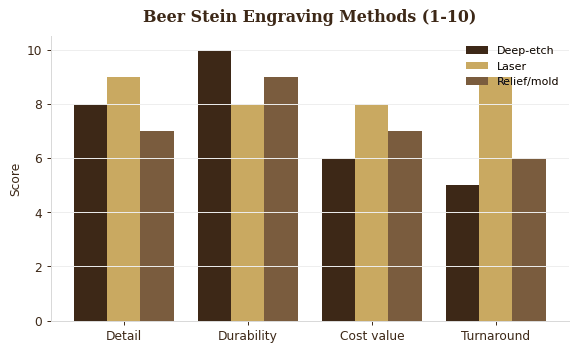
    Deep-etch engraving uses acid or abrasive etching to cut a permanent mark into the glass or ceramic surface itself, producing a frosted, tactile logo that will not wear off because there is nothing sitting on top of the surface to wear away. It is the most durable option for daily handling but takes longer to set up per design, which pushes turnaround out for a first-time order.

    Laser engraving burns a precise mark into the surface using a computer-guided beam, capturing fine detail and small text that etching struggles with, and it is fast to set up once artwork is ready, which suits a tight event or reorder timeline. Mold relief, by contrast, is not applied after the fact at all — it is cast into the stein during production, giving a raised, sculptural logo but requiring a mold investment that only pays off at real volume. The chart compares all three on what buyers care about most.

    Beer stein engraving methods compared on detail, durability, cost, and turnaround.
    Beer stein engraving methods compared on detail, durability, cost, and turnaround.

    Which method fits your order size

    A small taproom running a mug club under a few hundred members usually does best with laser engraving — fast turnaround, fine detail for a member number, and a reasonable per-unit cost. A larger brewery ordering thousands of steins for retail or a flagship release can justify the mold investment for relief, since the tooling cost spreads thin across volume.

    Ask any supplier quoting beer stein engraving to show you a physical sample under real light, not a rendering. Etching and laser marks read very differently depending on lighting and glass color, and a screen mockup rarely tells the full story. For thread and print methods on fabric goods that pair with a stein program, see our companion Custom Beer Steins for Beer Clubs & Mug Clubs: A Taproom Program Guide.

    Durability: what actually survives years of use

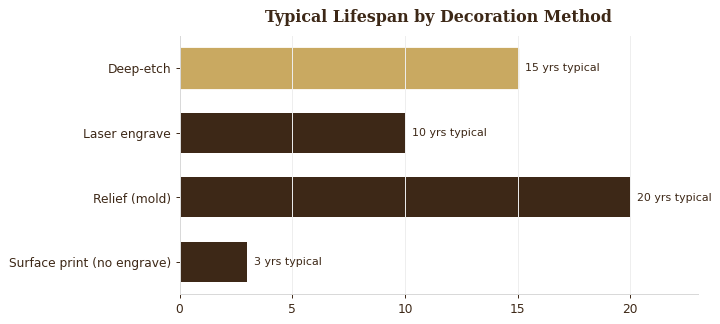
    Deep-etch and mold relief are both cut into or cast as part of the material, so they survive essentially the life of the stein — the mark cannot flake or rub off because it is not a coating. Laser engraving is nearly as durable, marking the surface itself rather than sitting on top of it, though very fine laser detail can soften slightly faster than a bolder etched mark under heavy commercial dishwasher use.

    Surface printing or a stick-on decal, by contrast, is not true beer stein engraving at all — it is a coating applied on top of the glass or ceramic, and it is the first thing to fade or peel under repeated washing. The lifespan chart below shows the real gap between genuine engraving methods and a surface-applied print.

    Typical lifespan of beer stein decoration by method, in years of regular use.
    Typical lifespan of beer stein decoration by method, in years of regular use.

    Choosing a method for your next order

    The table below matches engraving method to the most common ordering scenarios we see from breweries and taprooms.

    Scenario Best method Why
    Mug club, under 300 members Laser engraving Fast turnaround, fine detail for numbers
    Retail or flagship, 1,000+ Mold relief Tooling cost spreads across volume
    Premium gift or founder tier Deep-etch Most tactile, permanent, elevated feel

    Send vector artwork and confirm your quantity before requesting a quote, since method and price both hinge on volume. To compare stein materials this engraving pairs with, see our companion Custom Beer Steins for Beer Clubs & Mug Clubs: A Taproom Program Guide, and browse current styles across our custom beer steins range, or check our heritage for the full process.

    Working with a supplier to avoid engraving mistakes

    The single biggest source of engraving problems isn’t the method itself, it’s mismatched expectations between what a buyer pictures and what a given process can actually deliver. Fine hairline text that looks crisp in a vector file can blur under deep-etch because the etching process removes material at a minimum width, and a logo with subtle gradient shading won’t translate to laser engraving, which reads as a binary mark rather than a tonal one. Sending simplified, high-contrast artwork built for the specific method — not just a generic logo file — is what prevents a disappointing first proof.

    Always request a physical sample before committing to a full production run, especially for a first-time order or a new design. A supplier’s digital rendering cannot show how etching frosts differently depending on glass thickness, how a laser mark reads under warm taproom lighting versus daylight, or how a relief mold’s raised detail catches shadow. A ten-minute review of an actual sample under bar lighting catches problems that a screen mockup simply cannot reveal, and it costs far less than reworking a batch of finished steins.

    Lead time expectations should be set around the engraving method chosen, not around a generic ‘custom stein’ timeline. Laser engraving can often turn around a modest reorder in a couple of weeks once artwork is approved, which suits an active mug club adding members steadily. Mold relief requires tooling time up front that can run considerably longer, so a brewery planning a flagship retail launch around relief engraving needs to lock that decision months, not weeks, before the release date.

    Keep an approved proof on file for reorders

    Once a design and method pass inspection, keep that physical stein as your reference sample for every future batch. Comparing new production against it catches any quiet substitution in materials or engraving depth before a large order ships.

    It’s also worth knowing that a single stein program doesn’t have to commit to one method exclusively. Some breweries use laser engraving for the fast-turnaround, member-numbered steins that go out weekly to new mug club sign-ups, while reserving deep-etch or mold relief for a smaller batch of founder or anniversary steins that only need to be produced once a year. Splitting methods this way lets each part of the program use whichever process fits its actual pace and volume, rather than forcing a single method to serve both a constant trickle of new members and a once-a-year flagship release.

    Frequently asked questions

    Which beer stein engraving method lasts longest?

    Deep-etch and mold relief both last essentially the life of the stein since the mark is cut into or cast as part of the material. Laser is nearly as durable and is the faster, more affordable choice for smaller orders.

    Is laser engraving good enough for a mug club member number?

    Yes — laser engraving captures fine text and numbers well and has a fast enough turnaround to support ongoing mug club sign-ups without a long reorder wait.

    Choosing an engraving method?

    Send us your order size and timeline and we’ll recommend the right beer stein engraving, or design your stein.

    Design Your Stein

  • Beer Stein Care Guide: Cleaning, First Use & Storage

    Beer Stein Care Guide: Cleaning, First Use & Storage

    Beer Stein Care Guide: Cleaning, First Use, and Storage

    A custom stein is meant to last decades, and good beer stein care is what gets it there. Whether you own a single engraved keepsake or manage a shelf of taproom steins, a few simple habits protect the artwork, the lid mechanism, and the surface finish. This guide covers first use, everyday cleaning by material, and storage so your steins look as good on their tenth anniversary as on day one.

    The golden rule of beer stein care is gentle and consistent: warm water, mild soap, a soft touch, and thorough drying. Almost every problem — cloudy glass, tarnished pewter, a squeaky lid — traces back to a shortcut.

    First use: what to do with a new stein

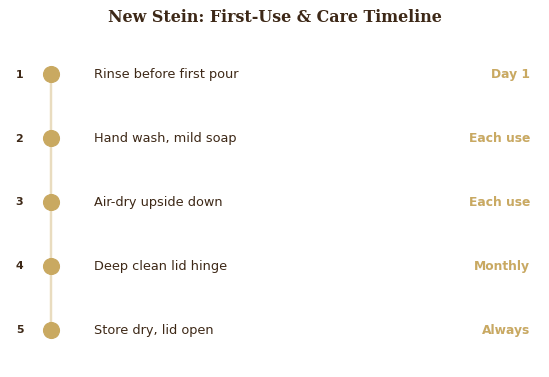
    Before the first pour, rinse a new stein in warm water to clear any manufacturing or engraving residue. Skip harsh detergents; a quick rinse and dry is enough. If your stein has a pewter or metal lid, open and close it a few times to seat the hinge, and avoid submerging the lid assembly.

    A simple first-use and ongoing care timeline for a new custom stein.
    A simple first-use and ongoing care timeline for a new custom stein.

    For stoneware and ceramic, a first rinse also removes any kiln dust. Give the piece a full air-dry before its first use so no moisture is trapped near the lid pin.

    Everyday cleaning by material

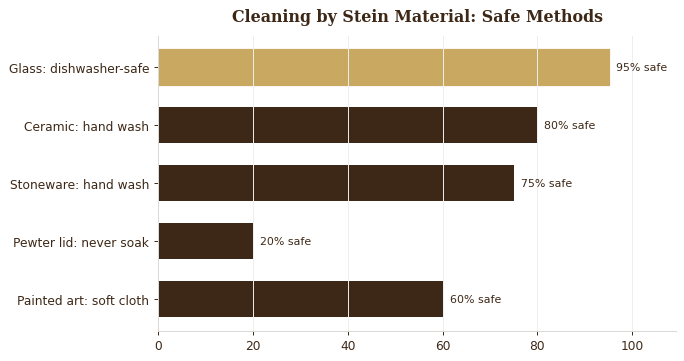
    How you clean depends on what the stein is made of. Glass steins without metal parts are usually dishwasher-safe, but hand washing preserves engraving contrast longer. Ceramic and stoneware should be hand washed to protect glaze and relief. Never soak a pewter lid — it can spot and dull — and always dry it by hand.

    Which cleaning methods are safe for each part of a custom stein.
    Which cleaning methods are safe for each part of a custom stein.
    Hard-water film on a glass stein? Wipe with a 50/50 white-vinegar and water mix, then rinse and hand-dry. Avoid abrasive pads, which scratch both glass and glaze.

    Cleaning the lid and hinge

    The lid hinge is the part most people forget. Once a month, wipe the hinge and thumb-lever with a barely damp cloth and dry immediately. A tiny amount of food-safe oil on a stubborn hinge keeps it swinging smoothly without gunk buildup.

    Storage that protects the artwork

    Store steins upright and dry, with lids propped slightly open so residual moisture escapes and the gasket does not compress. Keep them out of direct sunlight, which can fade painted art over time, and avoid stacking, which chips rims and scratches engraving.

    Task How often Why it matters
    Rinse & hand-dry Every use Prevents film & odor
    Wipe lid hinge Monthly Keeps lid smooth, spot-free
    Deep clean Seasonally Removes buildup safely
    Check storage Ongoing Protects art & rim

    Follow these habits and a custom stein stays display-ready for years. New to steins entirely? Start with our Glass vs Ceramic Beer Steins: Which to Engrave and Why comparison to choose the right material, and browse our custom beer steins to see what a custom order can look like.

    What damages a stein — and how to prevent it

    Most stein problems are avoidable once you know what causes them. Thermal shock is a common culprit: moving a stein straight from the freezer to hot dishwater, or pouring boiling liquid into a cold body, can crack glass and craze ceramic glaze. Let a stein return toward room temperature before big swings. Abrasion is the second offender; scouring pads and gritty cleansers leave micro-scratches that dull glass clarity and wear painted or printed art. The third is neglect of the lid mechanism, where moisture and residue seize hinges and tarnish pewter over time.

    Good beer stein care is really just a set of small habits that head off those three problems. Wash by hand with a soft cloth, avoid extreme temperature swings, dry the metal parts immediately, and store with airflow. None of it takes more than a minute per use, and it is the difference between a stein that looks tired in a year and one that looks new in a decade.

    Removing odors, stains, and hard-water film

    Even with good habits, a well-used stein occasionally needs a reset. For lingering beer odor, fill the stein with warm water and a tablespoon of baking soda, let it sit for an hour, then rinse; the baking soda neutralizes smells without abrasion. For hard-water film or light mineral scale on glass, the white-vinegar-and-water wipe covered earlier works well, and for stubborn spots a soak of a few minutes loosens deposits so they wipe away without scrubbing.

    Tannin or coffee-like staining inside ceramic responds to the same baking-soda soak. Whatever you use, keep acidic and abrasive treatments away from pewter lids and painted exteriors, and always finish with a clean-water rinse and a hand-dry. If a stein has a maker’s finish or gilding, test any treatment on a small area first.

    Displaying and rotating a collection

    If you own more than one stein, a little display discipline protects them. Keep steins out of direct sunlight, which fades painted art and can yellow some finishes over months. Give each piece a little space so lids and handles do not knock neighbors, and dust with a soft, dry cloth rather than a damp one that can sit in seams. For collectors who rotate pieces into use, a quick rinse before a long-stored stein’s next pour clears any settled dust.

    For taprooms and bars that run branded steins through daily service, the same principles scale up: hand-wash lanes for lidded pieces, a no-freezer rule for glued or painted art, and a monthly hinge-and-rim check catch problems before they become breakage. Building these steps into closing routines keeps a branded set looking sharp through heavy use.

    Common questions about beer stein care

    Are any custom steins dishwasher-safe?

    Plain glass steins without metal lids or applied art are often dishwasher-safe, but heat and detergent dull engraving contrast and can loosen glued components over time, so hand washing is the safest default for anything custom. Never put a pewter-lidded stein or a hand-painted piece in the dishwasher.

    How do I clean and protect a pewter lid?

    Wipe the lid with a soft, barely damp cloth and dry it immediately; never soak it. For light tarnish, a dedicated pewter polish used sparingly restores luster, but avoid harsh metal cleaners that can pit the surface. A monthly hinge wipe with a trace of food-safe oil keeps the lift smooth.

    Can I drink hot beverages from a stein?

    Stoneware and ceramic handle warm beverages better than glass, but avoid boiling liquids in any stein to prevent thermal shock, and keep hot contents away from glued art and lid gaskets. If a stein is intended as a display or collector piece, keep it to cold pours only.

    How should I store steins long-term?

    Store upright, dry, and out of sunlight, with lids propped slightly open so gaskets do not compress and moisture escapes. Avoid stacking, and if boxing steins away, wrap each in acid-free paper and keep the lid supported so the hinge is not bearing weight. Before a long-stored stein’s next pour, give it a quick warm-water rinse to clear any settled dust, and check the hinge still swings freely after months in the box.

    Building a stein collection or gift order?

    We’ll help you choose steins that are as easy to care for as they are to show off.

    Design Your Stein

  • Glass vs Ceramic Beer Steins: Which to Engrave and Why

    Glass vs Ceramic Beer Steins: Which to Engrave and Why

    Glass vs Ceramic Beer Steins: Which to Engrave and Why

    Choosing between a glass beer stein and a ceramic one is the first real decision most buyers face, and it shapes everything that follows: how the engraving reads, how cold the beer stays, and how the piece feels in the hand. A glass beer stein shows off the pour and takes crisp, high-contrast engraving, while ceramic and stoneware lean into heritage weight and better insulation. Neither is universally ‘better’ — the right pick depends on whether you are buying a gift, a keepsake, or taproom merch.

    This guide compares the three materials you will actually be quoted on — glass, ceramic, and traditional stoneware — across the attributes that matter for a custom order, then walks through quantity pricing so you can budget a run with confidence.

    How a glass beer stein compares to ceramic and stoneware

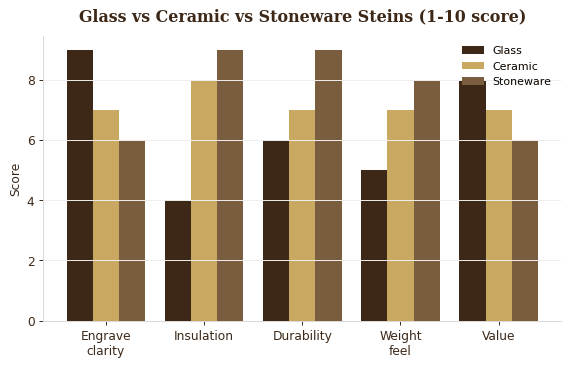
    A glass beer stein is prized for one thing above all: clarity. Rotary and laser engraving cut a frosted, high-contrast mark into glass that pops without any ink, which is why crests, monograms, and logos look sharpest on it. The trade-off is insulation — glass warms faster than a thick-walled ceramic body — and a slightly more delicate feel.

    Ceramic sits in the middle: good insulation, a substantial hand-feel, and a smooth surface that takes both engraving and full-color art. Stoneware, the classic Bavarian material, is the heaviest and best-insulating of the three, with a rustic surface that suits relief detail and traditional scenes. The chart below scores each material on the attributes buyers ask about most.

    Relative strengths of glass, ceramic, and stoneware steins across five buying criteria.
    Relative strengths of glass, ceramic, and stoneware steins across five buying criteria.

    When to choose each

    Pick a glass beer stein for wedding parties, corporate logos, and any design where a clean, legible mark is the point. Choose ceramic when you want a gift that feels premium and keeps beer cold through a long toast. Reach for stoneware for heritage gifts, Oktoberfest runs, and collectors who want the authentic beer-hall look and heft.

    Ordering for a mixed group? Many buyers pair a glass beer stein for the logo-forward corporate order with ceramic for VIP or milestone recipients — same artwork, two tiers of gift.

    What engraving looks like on each material

    Engraving depth and contrast behave differently by material. On a glass beer stein the mark is subtractive and frosted, so fine serif type and thin logo lines survive well. On ceramic and stoneware, deeper relief and glaze interactions favor bolder shapes; hairline details can fill in, so simplify intricate logos before you commit to a large ceramic run.

    If your artwork is a detailed crest or lots of small text, request a proof on your chosen material before the full run — a five-minute review prevents a boxed pallet of steins where the tagline is unreadable.

    Quantity pricing: what a custom run actually costs

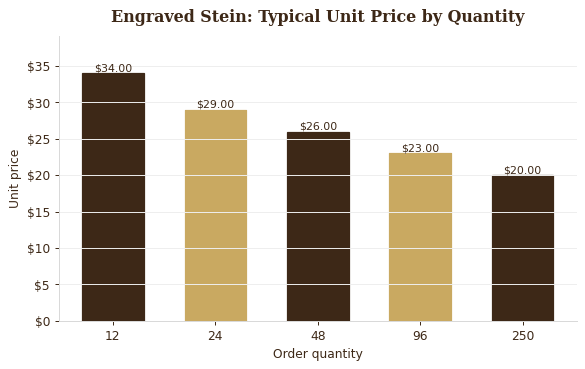
    Unit price on custom steins drops steadily with volume as setup and engraving time amortize across more pieces. The curve below reflects typical engraved-stein pricing; glass and ceramic track closely, while heavier stoneware and multi-color art carry a premium.

    Typical per-unit pricing for engraved steins as order quantity increases.
    Typical per-unit pricing for engraved steins as order quantity increases.
    Order size Best fit Notes
    12–24 Wedding party, small team Personalize each with a name
    48–96 Taproom retail, corporate gifts One logo, consistent artwork
    250+ Event & festival runs Lowest unit cost; lock art early

    Whichever material you choose, send vector artwork, confirm the engraving area for your stein shape, and approve a physical or digital proof. Keep your finished pieces looking new with our Beer Stein Care Guide: Cleaning, First Use & Storage, and see how other buyers spec their orders across our custom beer steins range.

    A closer look at each material’s origins and feel

    Understanding where each material comes from helps explain how it behaves in your hand and under an engraver’s tool. A glass beer stein is typically pressed or blown from soda-lime or higher-clarity crystal-style glass, then annealed for strength; the result is a smooth, non-porous surface that shows the color of the beer and takes a clean frosted mark. Ceramic steins are formed from refined clay, glazed, and kiln-fired, giving them a denser wall and a warmer, more opaque body. Traditional stoneware is fired at higher temperatures until the clay vitrifies, which is what gives an authentic Bavarian stein its heft, its faint ring when tapped, and its excellent insulation.

    Those manufacturing differences translate directly into the drinking experience. Glass feels lighter and more contemporary and keeps the visual focus on the pour, which is why it suits logo-forward and modern designs. Ceramic and stoneware feel substantial and traditional, and their thicker walls hold temperature longer, which is why they dominate heritage gifting and Oktoberfest programs. If the recipient values the ritual and weight of a ‘proper’ stein, lean ceramic or stoneware; if they value clarity and a clean, modern logo, lean glass.

    Lids, handles, and capacity across the three materials

    Material also shapes the hardware and proportions you can choose. Classic hinged pewter or metal lids pair most naturally with ceramic and stoneware bodies, reinforcing the heritage look, though lidded glass steins are available for buyers who want the traditional silhouette with a visible pour. Handle size and thumb-lift design matter for comfort: a well-proportioned handle keeps a full stein balanced and is worth confirming on a proof, especially for larger capacities.

    Capacity is another decision that interacts with material. Steins commonly run from a half-liter up to a full liter (the classic Oktoberfest Mass), and heavier stoneware at a full liter becomes a genuinely weighty piece. For gifting where the stein will actually be used regularly, a half-liter glass or ceramic body is easy to handle; for display, ceremony, and collector appeal, a full-liter stoneware stein makes a statement. Match capacity to whether the stein is a daily drinker or a mantel piece.

    Common questions about glass and ceramic steins

    Is a glass beer stein more fragile than ceramic?

    A quality glass beer stein is annealed for everyday durability and stands up well to normal use, but glass and ceramic both chip if knocked against a hard edge. Stoneware is the most impact-resistant of the three thanks to its dense, vitrified body. For high-traffic taproom use, stoneware or ceramic is the safer bet; for a gift that lives on a shelf and comes out for special pours, glass is perfectly durable.

    Which material keeps beer coldest?

    Thicker walls insulate better, so stoneware leads, ceramic follows closely, and glass warms fastest. Chilling any stein in the freezer for a few minutes before pouring extends the cold, and it makes the biggest difference on a glass body where there is less thermal mass to hold temperature.

    Can I put my full-color logo on any of them?

    Full-color art reproduces best on ceramic and glass via printing or a fired decal, while engraving on a glass beer stein produces a single-tone frosted mark that reads as premium and permanent. Stoneware suits relief and traditional scenes more than fine full-color logos. Send vector artwork and confirm the decoration method against your chosen material before a large run.

    What is the best material for a groomsmen or wedding order?

    For a coordinated wedding party, a glass beer stein with each groomsman’s initials engraved is a clean, photogenic choice; for a heritage or fall wedding, ceramic or stoneware feels warmer. Many couples mix, using glass for the logo-forward group order and a stoneware piece for a standout gift such as the best man or father of the groom.

    Ready to design your custom steins?

    Send us your logo or monogram and we’ll match it to the right material and quantity for your event.

    Design Your Stein

  • Custom Beer Steins: A Buyer’s Guide for Breweries, Events & Gifts

    Custom Beer Steins: A Buyer’s Guide for Breweries, Events & Gifts

    Custom Beer Steins: A Buyer’s Guide for Breweries, Events and Gifts

    Custom beer steins turn an ordinary pour into something people keep on the shelf long after the last sip. Whether you are a brewery building a taproom merch line, an event planner staging an Oktoberfest, or a groom searching for a groomsmen gift that will not end up in a drawer, the stein is one of the rare promotional items that guests genuinely want to own. This guide covers the material, decoration, capacity and ordering decisions so you can spec custom beer steins that look the part and hold up to real use.

    Glass vs. Ceramic vs. Stoneware: Choose the Body First

    The first fork is the body material, and it shapes both the look and the price. Clear glass steins and dimpled glass mugs show off the beer itself, feel modern, and take etching and print well, which makes them the default for breweries that want the liquid on display. Ceramic and stoneware steins read traditional and Bavarian, keep beer colder longer thanks to thicker walls, and give you a broad canvas for full-wrap art. Pewter-lidded stoneware is the heritage collector piece, reserved for premium gifts rather than a large giveaway.

    As a rough guide, printed glass is the most affordable per unit, ceramic sits a step up, and lidded stoneware is highest. Pick glass for volume and visible beer, ceramic for a classic Oktoberfest feel, and lidded stoneware for a keepsake.

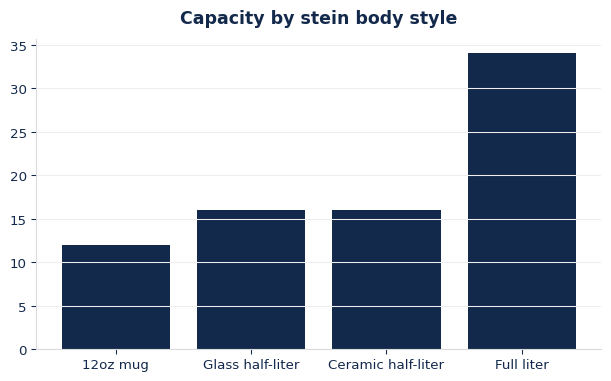
    Typical capacity and price positioning across stein body materials.
    How capacity and relative price compare across common stein body styles.

    Decoration: Engraving, Printing and Color

    How you decorate the stein sets its personality. Laser or sand etching on glass gives a frosted, permanent mark that never fades or peels, making it the top pick for engraved names and dates on gifts. Full-color printing (screen, pad or UV) puts logos and artwork on in bright color and is the workhorse for brewery branding and event runs. Ceramic can be decorated with ceramic decals and kiln-fired for a dishwasher-durable full-wrap design. For groomsmen and wedding parties, etching each person’s name or role onto an otherwise matching set is the detail that lands.

    Which to pick

    For permanence and a premium feel, choose engraving. For vivid multi-color logos at scale, choose printing. Many of the best orders combine both: a printed brand mark plus an engraved name, so the piece feels personal rather than mass-produced.

    Capacity and Sizing: Match the Pour

    Stein capacity should follow how it will be used. A half-liter (about 16oz) stein is the everyday taproom and gift size, easy to hold and store. The full liter (the classic Oktoberfest Mass, around 34oz) is the showpiece for festivals and photos but heavy when full. Smaller 12oz mugs suit tasting flights and lighter pours. If in doubt, the half-liter is the crowd-pleaser that people actually use at home.

    CapacityBest forNotes
    12 oz mugTastings, lighter poursLightest, lowest cost
    Half-liter (~16 oz)Taproom, gifts, everydayMost popular all-rounder
    Full liter (~34 oz)Oktoberfest, festivalsShowpiece; heavy when full
    Lidded stonewarePremium gifts, collectorsPewter lid, heritage look
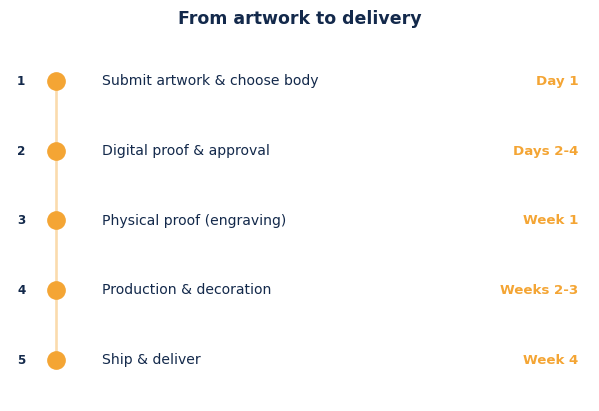
    Typical ordering timeline for custom beer steins from art to delivery.
    A typical timeline from artwork approval to delivery for a custom stein order.

    Quantity, Pricing and Lead Time

    Per-stein price drops as quantity climbs, because decoration setup (screens, decals or etch files) is a fixed cost spread across the run. Etching and full-wrap ceramic decoration cost more per unit than a simple one-color print, and lidded stoneware carries a premium regardless of volume. Treat any figure as an illustrative range rather than a quote, since body material, capacity and decoration complexity all move the number.

    Lead time is the other lever. Standard production commonly lands in a two-to-four-week window after art approval, with kiln-fired ceramic on the longer end. For a dated event like an Oktoberfest or a wedding, work backward from the day and build in a week of buffer for a physical proof.

    Tip: For a dated event, approve a physical proof before the full run, especially for engraving. Etch depth and logo placement read differently on curved glass than they do on a flat screen, and a five-minute proof review prevents a whole run of off-center marks.

    Matching the Stein to the Occasion

    The right spec shifts with the event. For a brewery taproom line, printed glass half-liters in your brand colors sell well and photograph brightly behind the bar. For an Oktoberfest or beer festival, full-liter ceramic steins deliver the traditional look and become the souvenir guests carry out. For groomsmen and wedding gifts, an engraved glass or lidded stoneware stein with each name reads as a genuine keepsake rather than swag. For corporate gifts, a tasteful etched logo on a quality body signals that thought went into it.

    Think about who keeps the stein afterward. A giveaway that looks cheap gets left on the table, while an attractive, well-made stein gets used at home and keeps your brand in view for years.

    Common Mistakes to Avoid

    A few predictable errors trip up otherwise good orders. The first is choosing a full-liter stein because it looks impressive, then finding guests struggle to lift it full; the half-liter is usually the smarter default. The second is oversizing a printed logo until the stein looks like an ad rather than a keepsake. The third is skipping the physical proof on engraved pieces, then discovering the etch is too shallow to read. Finally, buyers underestimate lead time on kiln-fired ceramic and leave themselves no buffer before a dated event.

    Confirm your body material, capacity and decoration method early, and reserve production time before peak fall festival season when stein demand and turnaround times both climb.

    The Bottom Line

    The best custom beer steins come from three aligned decisions: pick glass, ceramic or lidded stoneware based on the look and keep-value you want, choose engraving or printing to match whether the piece is a keepsake or a branded run, and size the capacity to how it will actually be used. Confirm quantity and lead time so pricing works in your favor, and always approve a proof on engraved work. Do that and you end up with steins people display and reuse rather than discard. Get those calls right and the stein stops being a throwaway giveaway and becomes a lasting piece of your brand, working the shelf in a customer’s kitchen every day of the year.

    Ready to design your custom beer steins?

    Send us your quantity, body style and artwork, and we will recommend a capacity, decoration method and timeline that fits your taproom, event or gift.

    Get a Quote

    More reading: browse our full range or learn how we produce custom beer steins. Questions on artwork or quantities? ask for a quote.