Category: Buying Guides

  • Beer Stein Lids Explained: Pewter, Glass & Ceramic

    Beer Stein Lids Explained: Pewter, Glass & Ceramic

    Beer Stein Lids Explained: Pewter, Glass & Ceramic

    Few details say “authentic beer stein” like a hinged lid. But a beer stein with lid isn’t just decoration β€” the lid style you choose affects the look, the weight, and even how the beer drinks. Whether you’re ordering steins for a wedding, a corporate award, or a festhall, knowing the lid options helps you spec a piece that feels right and lasts.

    This guide compares the three lid materials you’ll actually be offered on a custom beer stein with lid, what each adds, and when to skip the lid entirely.
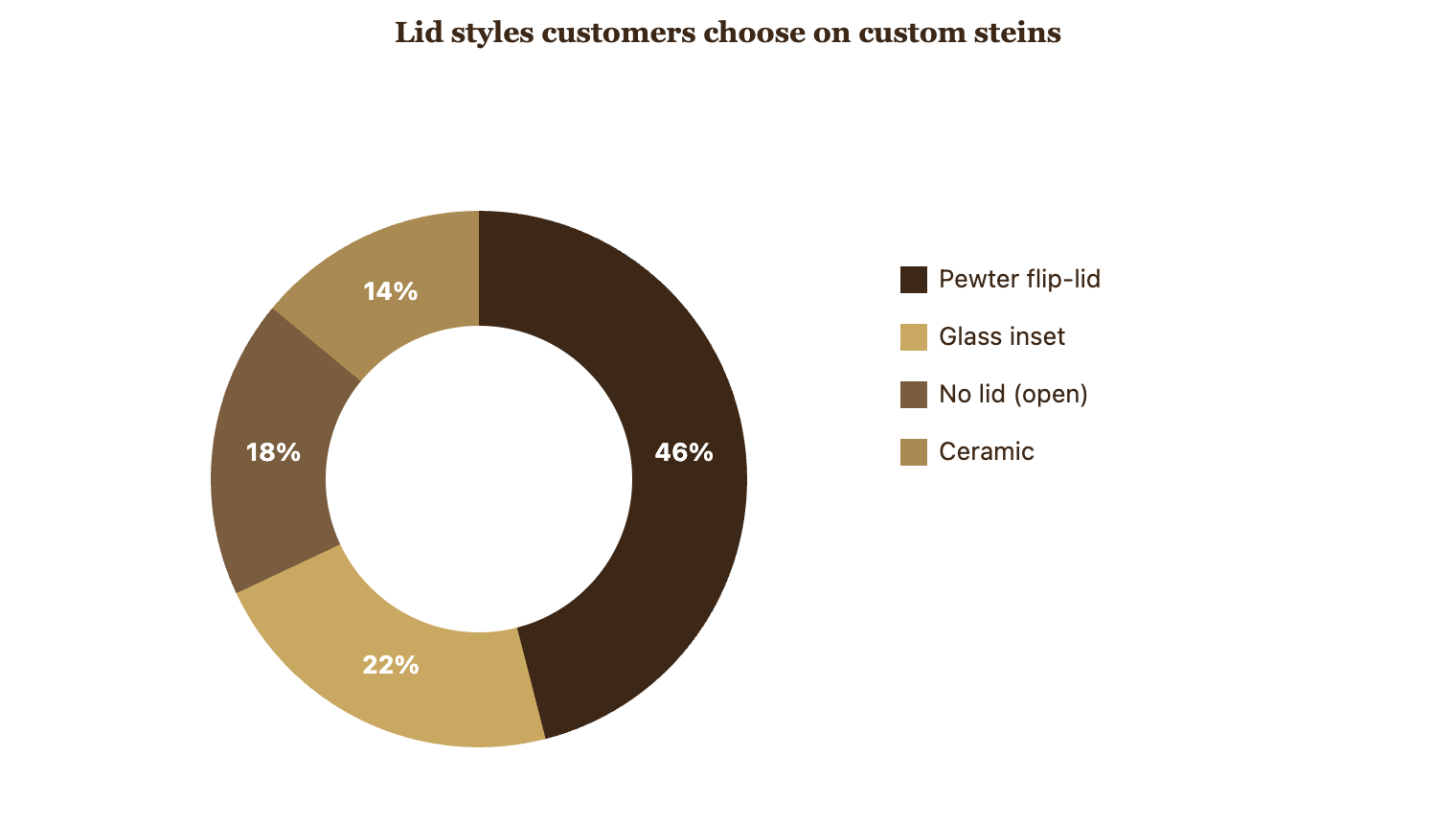
    Pewter flip-lids are the most popular choice for custom steins.
    Pewter flip-lids remain the most-requested style on custom steins.

    Why steins have lids at all

    The hinged lid is a genuine piece of history: it dates to laws requiring covered drinking vessels during plague eras to keep insects out. Today it’s mostly tradition and aesthetics β€” a thumb-lift lid is the detail that makes a stein look like a stein rather than a mug. It also keeps a head on the beer a little longer and shields the pour outdoors.

    The three lid materials

    Pewter (flip-lid)

    The classic. Pewter-look lids carry the most heritage weight, take engraving and relief detail beautifully, and are the top choice for commemorative and gift steins. They add a satisfying heft.

    Glass inset

    A clear glass panel set in a metal frame. It keeps the traditional silhouette while letting light through β€” a good middle ground for modern events and lighter-weight pieces.

    Ceramic

    A lid that matches the stoneware body for a seamless, monochrome look. Understated and durable, ceramic suits minimalist or single-color branding.
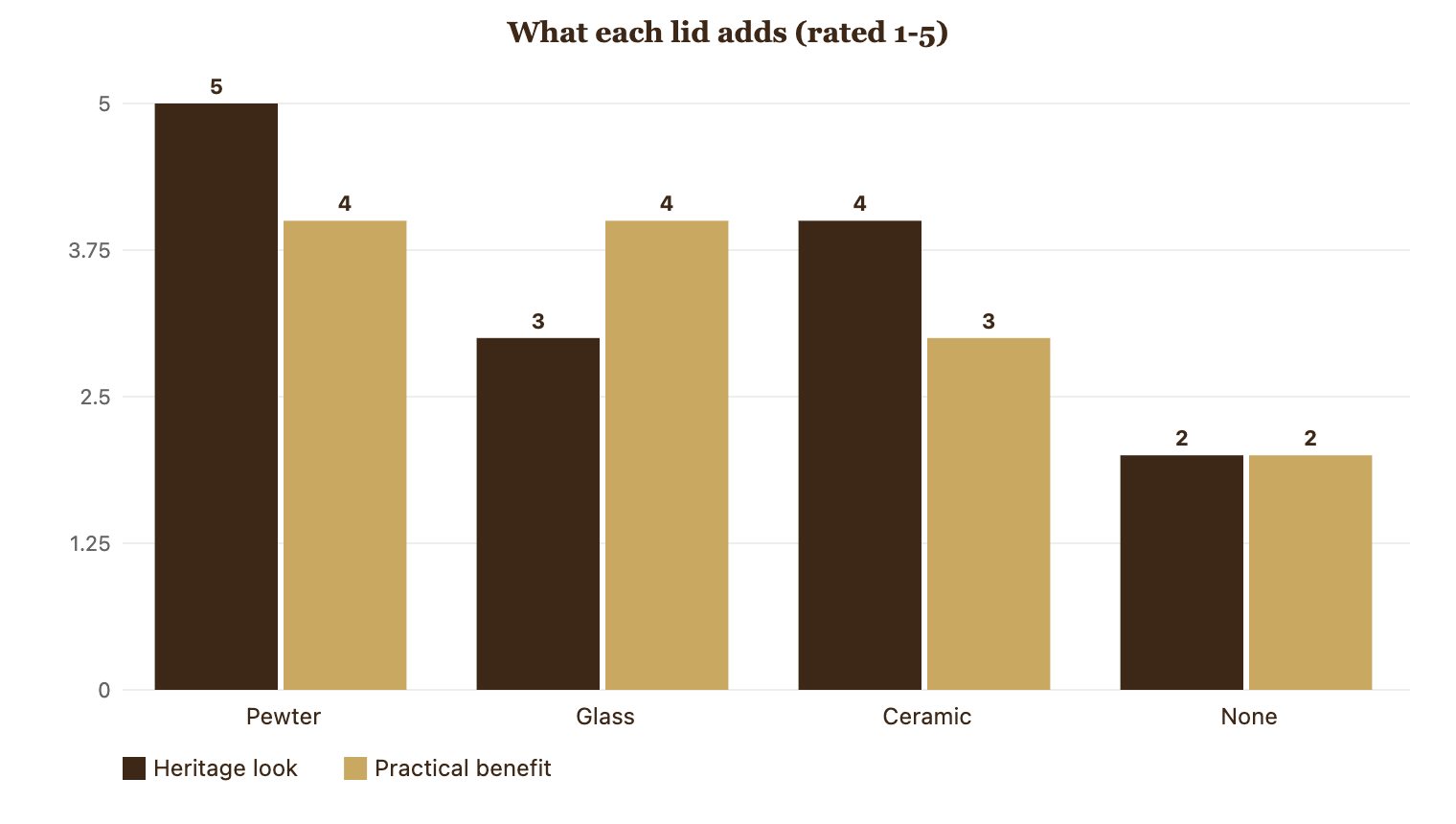
    Each lid material trades heritage look against practical benefits.
    Match the lid to your priority β€” heritage look versus everyday practicality.

    When to skip the lid

    Lidless steins are lighter, cheaper per unit, and easier to stack and ship β€” sensible for large giveaway runs where budget and volume matter more than ceremony. If the stein is a keepsake or award, the lid earns its place; if it’s high-volume swag, open-top is perfectly appropriate.

    Ordering in bulk for fall? Lid choice affects lead time and cost β€” factor it into your Oktoberfest ordering timeline before you lock quantities.

    Engraving and the lid

    Pewter and glass-frame lids both offer a second engraving surface β€” a date, initials, or a small crest on the thumb-lift reads as a premium touch on gift pieces. For material pairings and stein bodies, our materials guide covers how lids match different stoneware finishes.

    Bottom line

    Choosing a beer stein with lid comes down to purpose. Pewter flip-lids deliver maximum heritage and a premium feel for gifts and awards; glass insets modernize the look; ceramic keeps it seamless and durable; and open-top makes sense for high-volume swag. Match the lid to the occasion and your steins will look and feel exactly as intended.

    Design your custom stein

    Tell us the occasion and we’ll recommend a lid style, body, and engraving that fit.

    Design Your Stein

    About · Blog · Companion guide: Oktoberfest ordering timeline

  • Beer Stein Materials Explained: Stoneware, Glass, Ceramic & Pewter

    Beer Stein Materials Explained: Stoneware, Glass, Ceramic & Pewter

    Beer Stein Materials Explained: Stoneware, Glass, Ceramic & Pewter

    Few gifts carry as much weight β€” literally and sentimentally β€” as a well-made stein. But before you engrave a name or a crest, it pays to understand beer stein materials, because the material decides how the stein feels in the hand, how cold it keeps a pour, how crisply it takes an engraving, and how long it survives on a mantel. Choose well and you have an heirloom; choose poorly and you have a novelty mug.

    This guide compares the four classic beer stein materials β€” stoneware, glass, ceramic, and pewter β€” so you can match the right one to your occasion, whether it’s a groomsmen set, a corporate service award, or a single keepsake.

    Quick orientation: stoneware is the rugged traditionalist, glass shows off the beer, ceramic is the smooth all-rounder for color printing, and pewter is the heirloom showpiece with the finest engraving.

    The four classic beer stein materials

    Stoneware β€” the Bavarian standard

    Fired at high temperatures, stoneware is dense, chip-resistant, and naturally insulating. It is the material most people picture when they think of a German beer hall. Its thick walls keep beer cold and its matte or salt-glazed surface suits both relief molding and engraving. If you want tradition and durability in one, stoneware is the default.

    Glass β€” when the beer is the star

    Glass steins (often with a hinged pewter lid) let drinkers admire color and clarity. They take crisp laser etching beautifully, which frosts the design into the surface. The trade-off: glass is the least insulating of the four and the most fragile, so it suits display and lighter use more than rowdy toasting.

    Ceramic β€” the smooth all-rounder

    Ceramic offers a smooth, glossy canvas ideal for full-color printing and detailed logos. It is lighter than stoneware and more affordable at volume, making it a favorite for corporate runs where brand color accuracy matters more than old-world texture.

    Pewter β€” the heirloom showpiece

    Pewter holds the deepest, most detailed engraving of any material and develops a handsome patina over decades. It is the most expensive and the most ceremonial β€” reserved for milestone awards and gifts meant to be handed down.

    How the materials compare

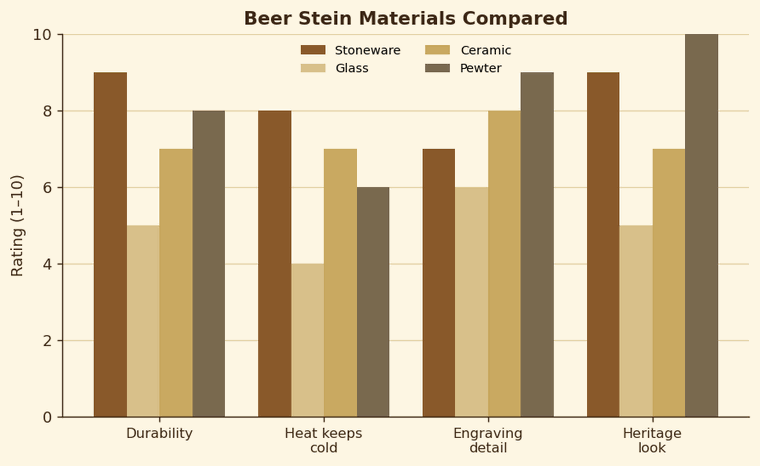
    The chart below rates each material on the factors buyers ask about most: durability, how well it keeps a pour cold, engraving detail, and that hard-to-fake heritage look.

    Grouped bar chart comparing stoneware, glass, ceramic and pewter beer steins on durability, cold retention, engraving detail and heritage look.

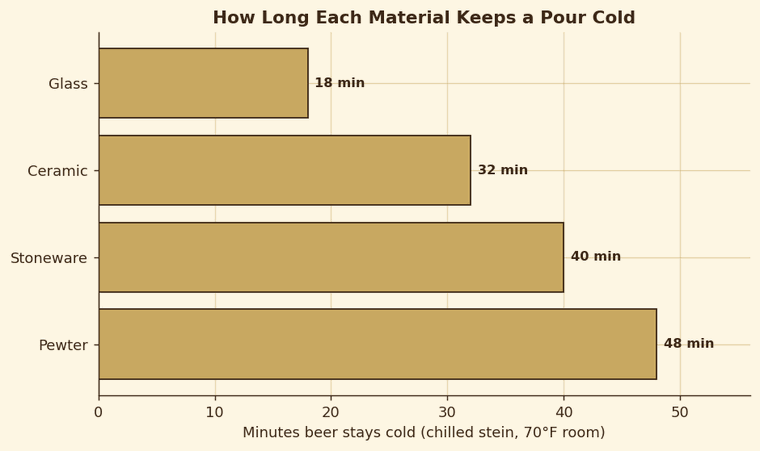
    Temperature is where beer stein materials differ most visibly to the drinker. Thicker, denser materials hold the cold far longer β€” a real consideration for outdoor toasts and slow-sipping occasions.

    Bar chart showing how many minutes a chilled beer stein keeps a pour cold by material.
    MaterialBest forEngraving styleWatch-out
    StonewareTradition, daily use, groomsmenRelief + engravingHeavier
    GlassShowing off the pour, displayLaser etchFragile, low insulation
    CeramicFull-color corporate logosColor printLess heritage feel
    PewterHeirloom awards, milestonesDeep engravingPremium cost

    Matching material to occasion

    For a groomsmen set you want durability and a classic feel β€” stoneware. For a corporate award honoring decades of service, pewter’s engraving and gravitas justify the cost. For a branded run where logo color is everything, ceramic prints cleanest. And for a gift to a craft-beer lover who wants to see the beer, glass wins. There is no single “best” material β€” only the right one for the moment, a theme we return to across our guides.

    Curious how engraving lead times and pricing change by quantity? Our sister post on engraved steins as retirement gifts walks through personalization and timing in detail.
    Ready to choose your material?
    Pick stoneware, glass, ceramic or pewter and add your engraving.
    Design Your Stein

    Learn more about our workshop or read the rest of the stein journal.

  • Beer Stein Sizes & Capacity: How to Choose the Right Pour

    Beer Stein Sizes & Capacity: How to Choose the Right Pour

    One of the first questions buyers ask when ordering custom drinkware is simple: what are the standard beer stein sizes, and which one is right for the job? Beer stein sizes range from a modest 0.3-liter pour to the towering 2-liter Maß, and the size you pick shapes everything from how your engraving looks to what the steins cost in bulk. This guide breaks down the common beer stein sizes, their real capacities, and how to match a size to weddings, corporate awards, beer halls, and collectors.

    Why Beer Stein Sizes Matter

    Size is not just about how much beer a stein holds. A larger stein gives you more surface area for an engraved crest, a longer dedication, or a multi-line monogram, while a smaller stein reads as refined and keeps per-unit costs down for big orders. The right choice balances the occasion, the artwork you want to feature, and your budget.

    Common Beer Stein Sizes and Capacities

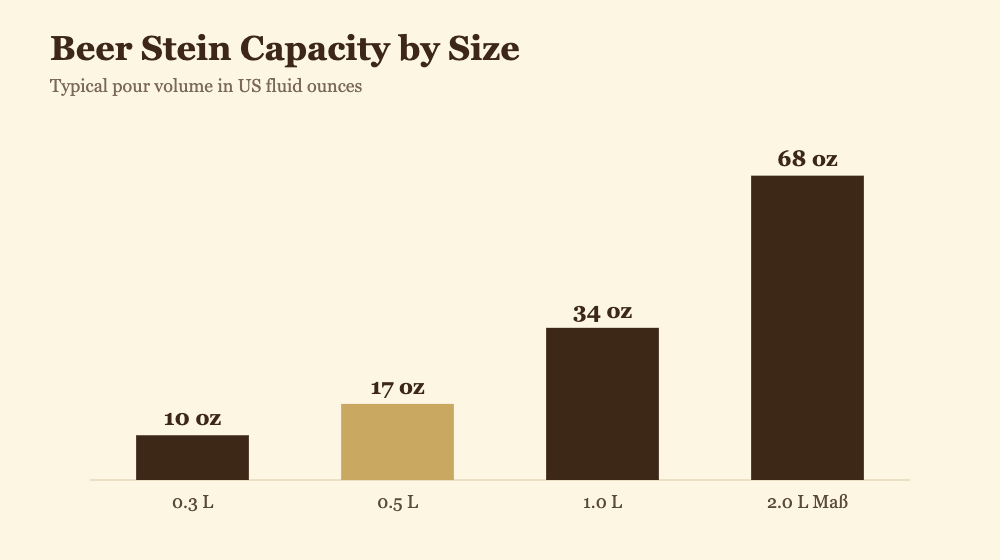
    German steins are sold in metric volumes, but most U.S. buyers think in ounces. Here is how the standard sizes translate.

    Bar chart of beer stein capacity by size: 0.3 L is about 10 oz, 0.5 L about 17 oz, 1.0 L about 34 oz, and the 2.0 L Maß about 68 oz
    Metric sizeApprox. capacityBest known as
    0.3 L~10 ozThe compact gift stein
    0.5 L~17 ozThe classic everyday stein
    1.0 L~34 ozThe full-liter Oktoberfest pour
    2.0 L Maß~68 ozThe showpiece / collector size

    From the 0.3-liter to the 2-liter Maß

    The 0.5-liter stein is the workhorse of the category — large enough to feel substantial, small enough to keep shipping and pricing reasonable on big runs. The full-liter is the iconic Oktoberfest vessel, and the 2-liter Maß is a statement piece that rarely leaves the shelf but always draws attention.

    Matching the Size to the Occasion

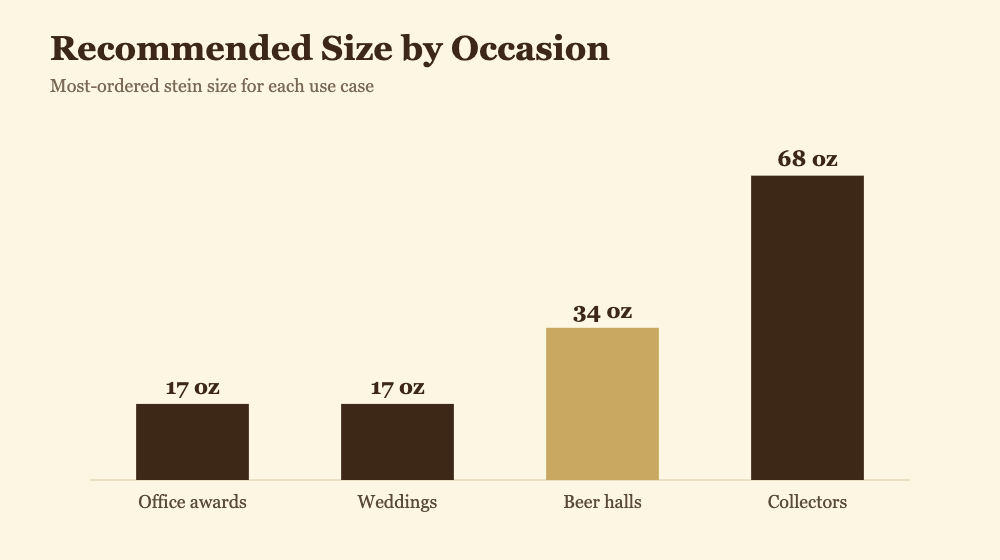
    Different events call for different beer stein sizes. The chart below shows the size we see ordered most often for each use case.

    Chart showing recommended stein size by occasion: office awards and weddings favor the 0.5 L, beer halls the 1 L, and collectors the 2 L Maß

    Gifts, awards, weddings, and collectors

    For corporate awards and wedding-party gifts, the 0.5-liter hits the sweet spot: it is keepsake-worthy and photographs beautifully with an engraved logo or date. Beer halls and breweries that actually serve from their steins lean toward the full liter. Collectors and milestone gifts — a retirement, a major anniversary — are where the dramatic 2-liter Maß earns its place.

    How Size Affects Engraving and Personalization

    Bigger steins offer more real estate, but that does not always mean better. A crisp crest and a name read cleaner on a 0.5-liter than a sprawling design stretched across a liter. Decide on your artwork first, then choose the smallest size that lets it breathe. For fine detail and multi-color crests, our team will advise on the size that reproduces best.

    Ordering Custom Steins in Bulk

    Per-unit price drops as quantity rises, and smaller sizes ship more affordably, so a 0.5-liter order of 100 steins is often the best value for groups. Mixing sizes — say, 0.5-liter for the group and a single 2-liter for the guest of honor — is a popular way to make one recipient feel special without blowing the budget.

    New to custom steins? Start with our how-we-work overview, browse ideas on the blog, or see options for weddings and corporate awards.

    Pick Your Size and Design Your Stein

    Once you know your occasion and artwork, choosing among the standard beer stein sizes is straightforward: 0.5-liter for most gifts and awards, the full liter for serving, and the 2-liter Maß when you want a showpiece. Ready to start? Send us your quantity, size, and logo for a quote with free mockups.

    Design Your Stein

  • How to Personalize a Beer Stein: Engraving Styles, Fonts & Gift Ideas

    How to Personalize a Beer Stein: Engraving Styles, Fonts & Gift Ideas

    How to Personalize a Beer Stein: Engraving Styles, Fonts & Gift Ideas

    A personalized beer stein turns an everyday drinking vessel into an heirloom — something a groomsman, a retiring colleague, or a beer-hall regular keeps on the shelf for decades. But “personalized” covers a surprising range of techniques, and the one you choose changes the look, the price, and how long the design lasts. This guide walks through every way to customize a beer stein, which method suits which occasion, and how to brief your engraver so the finished piece looks exactly how you pictured it.

    Whether you are ordering a single personalized beer stein for a wedding or a hundred for a corporate event, the same three decisions drive the result: the decoration method, the artwork, and the placement. Get those right and a personalized beer stein reads as crafted, not clip-art.

    The four ways to personalize a beer stein

    Each method marks the surface differently. Here is how they compare on durability, detail, and feel.

    MethodLookDurabilityBest for
    Laser engravingCrisp frosted etchPermanentLogos, names, dates
    Sandblast etchingDeep, tactile reliefPermanentCrests, heavy artwork
    Color printing (UV)Full-color, photographicGoodBrand colors, photos
    Hand paintingTraditional, artisanalCare-dependentHeritage & Bavarian styles

    Laser engraving

    The workhorse for a personalized beer stein. A laser frosts the glass or ceramic to leave a clean, permanent mark that never fades or peels. It is ideal for names, dates, monograms, and single-color logos, and it is the most cost-effective option at volume.

    Sandblast etching

    Sandblasting cuts deeper than a laser, producing a tactile, dimensional design you can feel. It shines for coats of arms, fraternity crests, and detailed illustrations where depth adds richness.

    UV color printing

    When you need brand colors or a full-color photo wrapped around the stein, UV printing delivers. It is the right call for company logos with specific Pantones or playful, colorful designs.

    Hand painting

    For a heritage, old-world look, traditional hand-painting can’t be beaten — though it costs more and needs gentler care. It is the most authentically Bavarian finish.

    Quick rule: names & dates → laser; crests & depth → sandblast; brand colors → UV print; old-world charm → hand paint.

    What it costs by quantity

    Personalization has a setup component, so the per-stein price drops as your order grows. The relative pattern below shows why a personalized beer stein for a wedding party of 12 costs more each than a corporate run of 100.

    1 stein (single gift)Highest /unit
    12 steins (wedding party)
    50 steins (event)
    100+ steins (corporate)Lowest /unit

    Personalized beer stein ideas by occasion

    I.Groomsmen & weddings — name, role, and wedding date
    II.Retirement & service awards — years of service and a crest
    III.Breweries & taprooms — logo steins for regulars and merch
    IV.Clubs & reunions — crest plus member name

    Choosing the right artwork

    Vector logos and simple line art engrave the cleanest. Photographs and gradients belong on UV-printed steins, not engraved ones. Always send the highest-resolution file you have, and keep text short — a name and a date reads better than a paragraph.

    Placement that looks intentional

    Center a single monogram on the face of the stein; wrap repeating logos around the body; reserve the handle side for a small date or initials. A good shop will mock up the placement before anything is cut.

    Ordering for a group? Collect every name and spelling in a single spreadsheet up front — re-engraving a misspelled personalized beer stein is the most common (and avoidable) delay.

    How to brief your engraver

    Give your shop four things and your personalized beer stein will come out right the first time: the quantity, the decoration method, a vector or high-res file, and the exact text with spellings confirmed. Confirm the proof before production, and ask about lead time — engraving and etching are quick, but hand-painting and large corporate runs need more runway.

    Done well, a personalized beer stein is the rare gift that gets used and displayed. Match the method to the occasion, keep the artwork clean, and lock the details before production.

    Ready to create yours?
    Design Your Stein

    More reading: learn the craft on our about page, browse the blog, or see our Oktoberfest beer stein guide.

  • Engraved Beer Steins: Laser vs Hand-Etched vs Relief Explained

    Engraved Beer Steins: Laser vs Hand-Etched vs Relief Explained

    An engraved beer stein turns a simple drinking vessel into an heirloom, but not all engraving is created equal. The same name and date can be laser-etched in minutes, cut by hand over an afternoon, or cast as raised relief in the mold itself. Each technique carries its own look, durability, and price, and choosing the right one depends on whether you are making a single keepsake or a hundred groomsmen gifts. This guide compares the three main ways to engrave a stein so you know exactly what you are paying for.

    Before you order a custom beer stein, it helps to understand that the engraving method shapes the entire character of the piece, from how the lettering catches the light to how it holds up after years of toasts.

    The Three Engraving Methods

    Laser etching uses a focused beam to mark the surface with crisp, repeatable precision. Hand engraving uses a rotary tool or graver guided by an artisan, giving each piece subtle, one-of-a-kind character. Relief casting builds the design into the ceramic itself, so the artwork is raised rather than cut in. The right pick balances volume, budget, and the feel you want.

    MethodLookBest forRelative cost
    Laser etchingCrisp, fine detailLogos, names, batches$
    Hand engravingArtisanal, uniqueSingle heirlooms$$$
    Relief castingRaised, traditionalHeritage designs$$

    Match the engraving method to your quantity and the feel you want.

    Laser Etching: Precision at Scale

    For corporate gifts, wedding parties, or any order above a handful, laser etching is usually the practical winner. It reproduces logos and text with exacting consistency, so the tenth stein looks identical to the first, and it keeps per-piece cost low. The mark is clean and durable, sitting just into the surface where it resists everyday wear. When you need an engraved beer stein program that looks uniform and professional, laser is the workhorse.

    Hand Engraving: One-of-a-Kind Character

    When the piece is the gift, a hand-engraved stein carries a warmth that machines cannot fake. Slight variations in line weight and depth are exactly what make it feel personal and collectible. It is the priciest and slowest route, which is why it shines for a single retirement gift, a milestone anniversary, or a presentation piece meant to be displayed as much as used.

    Relief Casting: Heritage in the Material

    Relief designs are built into traditional ceramic steins, giving that classic Bavarian look where scenes and crests stand proud of the surface. Because the artwork lives in the mold, relief is ideal for heritage motifs produced in repeatable runs. It splits the difference on cost and delivers the old-world feel many buyers picture when they imagine a German beer stein.

    Which Should You Choose?

    Order one meaningful keepsake and want artistry? Hand engraving. Outfitting a wedding party or company event with a consistent custom beer stein? Laser etching. Want that traditional raised-scene heritage look in a small run? Relief casting. Knowing the trade-offs up front means your finished steins look the way you imagined and last for decades of use.

    Design Your Stein

    Ready to create an engraved stein that lasts a lifetime? CustomBeerStein crafts personalized steins with the engraving method that fits your occasion and quantity. Learn more about our workshop, browse the blog, or start your design today.

    Not sure which material to engrave? Read our beer stein materials guide: ceramic vs glass vs pewter.