Engraving Styles for Beer Steins: Deep-Etch vs Laser vs Relief
Not all custom marks on a stein are actually engraved, and that difference decides whether the logo is still crisp after five years of dishwasher cycles or worn to a shadow after one. Beer stein engraving covers a handful of genuinely different processes — deep-etch, laser, and mold relief — each with its own look, durability, and turnaround. Picking the wrong one for your volume and timeline is the most common regret we hear from brewery buyers ordering their first batch.
This guide breaks down what each beer stein engraving method actually does to the glass or ceramic surface, how they compare on detail and lifespan, and how to choose based on your order size and deadline.
How the three engraving methods actually work
Deep-etch engraving uses acid or abrasive etching to cut a permanent mark into the glass or ceramic surface itself, producing a frosted, tactile logo that will not wear off because there is nothing sitting on top of the surface to wear away. It is the most durable option for daily handling but takes longer to set up per design, which pushes turnaround out for a first-time order.
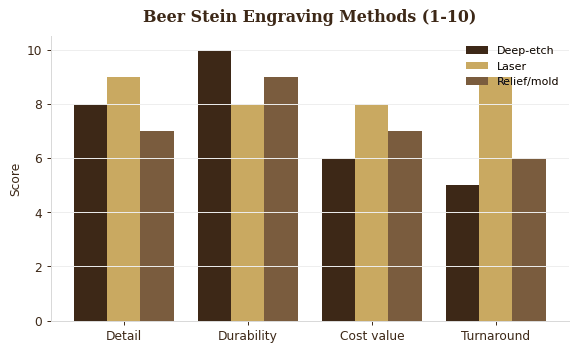
Laser engraving burns a precise mark into the surface using a computer-guided beam, capturing fine detail and small text that etching struggles with, and it is fast to set up once artwork is ready, which suits a tight event or reorder timeline. Mold relief, by contrast, is not applied after the fact at all — it is cast into the stein during production, giving a raised, sculptural logo but requiring a mold investment that only pays off at real volume. The chart compares all three on what buyers care about most.
Which method fits your order size
A small taproom running a mug club under a few hundred members usually does best with laser engraving — fast turnaround, fine detail for a member number, and a reasonable per-unit cost. A larger brewery ordering thousands of steins for retail or a flagship release can justify the mold investment for relief, since the tooling cost spreads thin across volume.
Durability: what actually survives years of use
Deep-etch and mold relief are both cut into or cast as part of the material, so they survive essentially the life of the stein — the mark cannot flake or rub off because it is not a coating. Laser engraving is nearly as durable, marking the surface itself rather than sitting on top of it, though very fine laser detail can soften slightly faster than a bolder etched mark under heavy commercial dishwasher use.
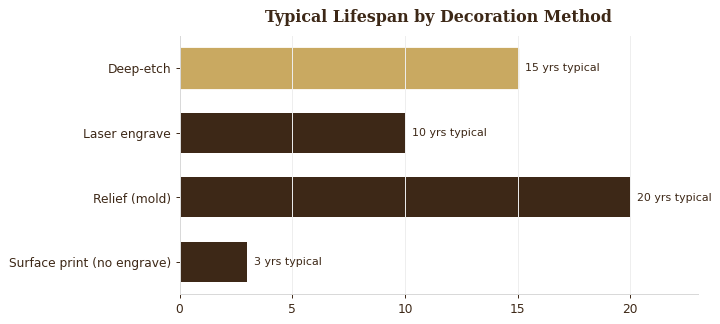
Surface printing or a stick-on decal, by contrast, is not true beer stein engraving at all — it is a coating applied on top of the glass or ceramic, and it is the first thing to fade or peel under repeated washing. The lifespan chart below shows the real gap between genuine engraving methods and a surface-applied print.
Choosing a method for your next order
The table below matches engraving method to the most common ordering scenarios we see from breweries and taprooms.
| Scenario | Best method | Why |
|---|---|---|
| Mug club, under 300 members | Laser engraving | Fast turnaround, fine detail for numbers |
| Retail or flagship, 1,000+ | Mold relief | Tooling cost spreads across volume |
| Premium gift or founder tier | Deep-etch | Most tactile, permanent, elevated feel |
Send vector artwork and confirm your quantity before requesting a quote, since method and price both hinge on volume. To compare stein materials this engraving pairs with, see our companion Custom Beer Steins for Beer Clubs & Mug Clubs: A Taproom Program Guide, and browse current styles across our custom beer steins range, or check our heritage for the full process.
Working with a supplier to avoid engraving mistakes
The single biggest source of engraving problems isn’t the method itself, it’s mismatched expectations between what a buyer pictures and what a given process can actually deliver. Fine hairline text that looks crisp in a vector file can blur under deep-etch because the etching process removes material at a minimum width, and a logo with subtle gradient shading won’t translate to laser engraving, which reads as a binary mark rather than a tonal one. Sending simplified, high-contrast artwork built for the specific method — not just a generic logo file — is what prevents a disappointing first proof.
Always request a physical sample before committing to a full production run, especially for a first-time order or a new design. A supplier’s digital rendering cannot show how etching frosts differently depending on glass thickness, how a laser mark reads under warm taproom lighting versus daylight, or how a relief mold’s raised detail catches shadow. A ten-minute review of an actual sample under bar lighting catches problems that a screen mockup simply cannot reveal, and it costs far less than reworking a batch of finished steins.
Lead time expectations should be set around the engraving method chosen, not around a generic ‘custom stein’ timeline. Laser engraving can often turn around a modest reorder in a couple of weeks once artwork is approved, which suits an active mug club adding members steadily. Mold relief requires tooling time up front that can run considerably longer, so a brewery planning a flagship retail launch around relief engraving needs to lock that decision months, not weeks, before the release date.
Keep an approved proof on file for reorders
Once a design and method pass inspection, keep that physical stein as your reference sample for every future batch. Comparing new production against it catches any quiet substitution in materials or engraving depth before a large order ships.
It’s also worth knowing that a single stein program doesn’t have to commit to one method exclusively. Some breweries use laser engraving for the fast-turnaround, member-numbered steins that go out weekly to new mug club sign-ups, while reserving deep-etch or mold relief for a smaller batch of founder or anniversary steins that only need to be produced once a year. Splitting methods this way lets each part of the program use whichever process fits its actual pace and volume, rather than forcing a single method to serve both a constant trickle of new members and a once-a-year flagship release.
Frequently asked questions
Which beer stein engraving method lasts longest?
Deep-etch and mold relief both last essentially the life of the stein since the mark is cut into or cast as part of the material. Laser is nearly as durable and is the faster, more affordable choice for smaller orders.
Is laser engraving good enough for a mug club member number?
Yes — laser engraving captures fine text and numbers well and has a fast enough turnaround to support ongoing mug club sign-ups without a long reorder wait.
Choosing an engraving method?
Send us your order size and timeline and we’ll recommend the right beer stein engraving, or design your stein.