Glass vs Ceramic Beer Steins: Which to Engrave and Why
Choosing between a glass beer stein and a ceramic one is the first real decision most buyers face, and it shapes everything that follows: how the engraving reads, how cold the beer stays, and how the piece feels in the hand. A glass beer stein shows off the pour and takes crisp, high-contrast engraving, while ceramic and stoneware lean into heritage weight and better insulation. Neither is universally ‘better’ — the right pick depends on whether you are buying a gift, a keepsake, or taproom merch.
This guide compares the three materials you will actually be quoted on — glass, ceramic, and traditional stoneware — across the attributes that matter for a custom order, then walks through quantity pricing so you can budget a run with confidence.
How a glass beer stein compares to ceramic and stoneware
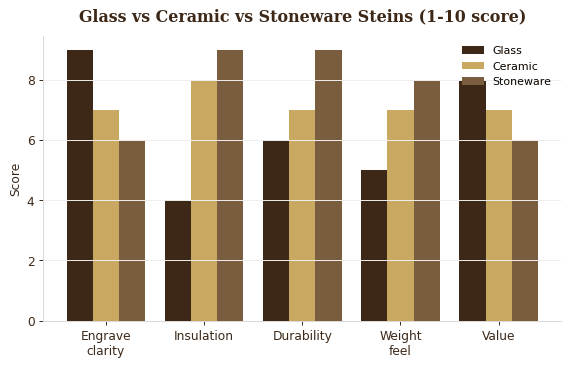
A glass beer stein is prized for one thing above all: clarity. Rotary and laser engraving cut a frosted, high-contrast mark into glass that pops without any ink, which is why crests, monograms, and logos look sharpest on it. The trade-off is insulation — glass warms faster than a thick-walled ceramic body — and a slightly more delicate feel.
Ceramic sits in the middle: good insulation, a substantial hand-feel, and a smooth surface that takes both engraving and full-color art. Stoneware, the classic Bavarian material, is the heaviest and best-insulating of the three, with a rustic surface that suits relief detail and traditional scenes. The chart below scores each material on the attributes buyers ask about most.
When to choose each
Pick a glass beer stein for wedding parties, corporate logos, and any design where a clean, legible mark is the point. Choose ceramic when you want a gift that feels premium and keeps beer cold through a long toast. Reach for stoneware for heritage gifts, Oktoberfest runs, and collectors who want the authentic beer-hall look and heft.
What engraving looks like on each material
Engraving depth and contrast behave differently by material. On a glass beer stein the mark is subtractive and frosted, so fine serif type and thin logo lines survive well. On ceramic and stoneware, deeper relief and glaze interactions favor bolder shapes; hairline details can fill in, so simplify intricate logos before you commit to a large ceramic run.
If your artwork is a detailed crest or lots of small text, request a proof on your chosen material before the full run — a five-minute review prevents a boxed pallet of steins where the tagline is unreadable.
Quantity pricing: what a custom run actually costs
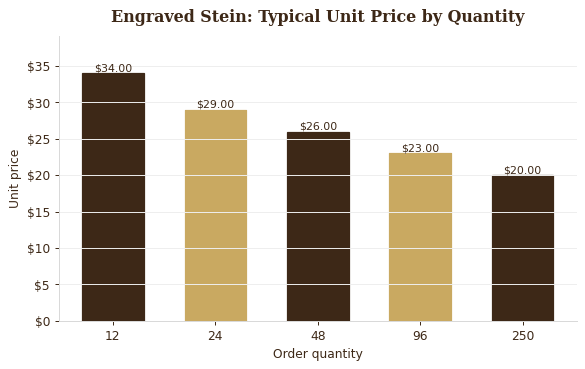
Unit price on custom steins drops steadily with volume as setup and engraving time amortize across more pieces. The curve below reflects typical engraved-stein pricing; glass and ceramic track closely, while heavier stoneware and multi-color art carry a premium.
| Order size | Best fit | Notes |
|---|---|---|
| 12–24 | Wedding party, small team | Personalize each with a name |
| 48–96 | Taproom retail, corporate gifts | One logo, consistent artwork |
| 250+ | Event & festival runs | Lowest unit cost; lock art early |
Whichever material you choose, send vector artwork, confirm the engraving area for your stein shape, and approve a physical or digital proof. Keep your finished pieces looking new with our Beer Stein Care Guide: Cleaning, First Use & Storage, and see how other buyers spec their orders across our custom beer steins range.
A closer look at each material’s origins and feel
Understanding where each material comes from helps explain how it behaves in your hand and under an engraver’s tool. A glass beer stein is typically pressed or blown from soda-lime or higher-clarity crystal-style glass, then annealed for strength; the result is a smooth, non-porous surface that shows the color of the beer and takes a clean frosted mark. Ceramic steins are formed from refined clay, glazed, and kiln-fired, giving them a denser wall and a warmer, more opaque body. Traditional stoneware is fired at higher temperatures until the clay vitrifies, which is what gives an authentic Bavarian stein its heft, its faint ring when tapped, and its excellent insulation.
Those manufacturing differences translate directly into the drinking experience. Glass feels lighter and more contemporary and keeps the visual focus on the pour, which is why it suits logo-forward and modern designs. Ceramic and stoneware feel substantial and traditional, and their thicker walls hold temperature longer, which is why they dominate heritage gifting and Oktoberfest programs. If the recipient values the ritual and weight of a ‘proper’ stein, lean ceramic or stoneware; if they value clarity and a clean, modern logo, lean glass.
Lids, handles, and capacity across the three materials
Material also shapes the hardware and proportions you can choose. Classic hinged pewter or metal lids pair most naturally with ceramic and stoneware bodies, reinforcing the heritage look, though lidded glass steins are available for buyers who want the traditional silhouette with a visible pour. Handle size and thumb-lift design matter for comfort: a well-proportioned handle keeps a full stein balanced and is worth confirming on a proof, especially for larger capacities.
Capacity is another decision that interacts with material. Steins commonly run from a half-liter up to a full liter (the classic Oktoberfest Mass), and heavier stoneware at a full liter becomes a genuinely weighty piece. For gifting where the stein will actually be used regularly, a half-liter glass or ceramic body is easy to handle; for display, ceremony, and collector appeal, a full-liter stoneware stein makes a statement. Match capacity to whether the stein is a daily drinker or a mantel piece.
Common questions about glass and ceramic steins
Is a glass beer stein more fragile than ceramic?
A quality glass beer stein is annealed for everyday durability and stands up well to normal use, but glass and ceramic both chip if knocked against a hard edge. Stoneware is the most impact-resistant of the three thanks to its dense, vitrified body. For high-traffic taproom use, stoneware or ceramic is the safer bet; for a gift that lives on a shelf and comes out for special pours, glass is perfectly durable.
Which material keeps beer coldest?
Thicker walls insulate better, so stoneware leads, ceramic follows closely, and glass warms fastest. Chilling any stein in the freezer for a few minutes before pouring extends the cold, and it makes the biggest difference on a glass body where there is less thermal mass to hold temperature.
Can I put my full-color logo on any of them?
Full-color art reproduces best on ceramic and glass via printing or a fired decal, while engraving on a glass beer stein produces a single-tone frosted mark that reads as premium and permanent. Stoneware suits relief and traditional scenes more than fine full-color logos. Send vector artwork and confirm the decoration method against your chosen material before a large run.
What is the best material for a groomsmen or wedding order?
For a coordinated wedding party, a glass beer stein with each groomsman’s initials engraved is a clean, photogenic choice; for a heritage or fall wedding, ceramic or stoneware feels warmer. Many couples mix, using glass for the logo-forward group order and a stoneware piece for a standout gift such as the best man or father of the groom.
Ready to design your custom steins?
Send us your logo or monogram and we’ll match it to the right material and quantity for your event.