Category: Custom Beer Steins

  • Custom Beer Steins for Beer Clubs & Mug Clubs: A Taproom Program Guide

    Custom Beer Steins for Beer Clubs & Mug Clubs: A Taproom Program Guide

    Custom Beer Steins for Beer Clubs & Mug Clubs: A Taproom Program Guide

    A mug club is one of the cheapest, highest-return loyalty programs a taproom can run, and the stein itself is the whole mechanism. Mug club steins give a member a reason to come back weekly for a discounted fill, a shelf spot behind the bar that says ‘this is mine,’ and a keepsake that keeps the brewery’s name on a mantel long after the membership year ends. Get the stein and the program structure right, and it pays for itself in repeat visits within a season.

    This guide covers which stein material fits a mug club budget and durability needs, the program elements that make members actually renew, and how to plan a numbered, branded run for your taproom.

    Choosing a stein material for daily mug club use

    A mug club stein gets handled roughly — grabbed off a shelf, filled and refilled, occasionally dropped — so material choice is really a durability decision first and a look-and-feel decision second. Glass steins are the most durable under daily handling and the fastest to fill and rinse behind a busy bar, which matters when a taproom is turning members through on a Friday night.

    Ceramic steins carry the most premium, old-world feel and take a crisp printed or embossed logo beautifully, making them the popular choice for a program that wants to feel like a real membership perk rather than a giveaway cup. Stoneware sits at the top for perceived value and heft but is the heaviest and priciest option, best reserved for a founding-member or lifetime tier. The chart compares the three on what mug club programs actually weigh.
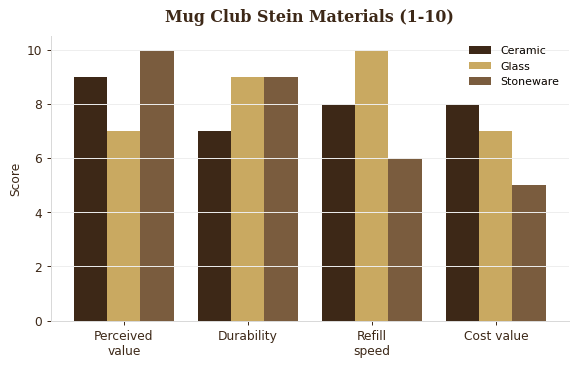
    Stein materials compared for durability, value, and daily taproom use.
    Stein materials compared for durability, value, and daily taproom use.

    Matching material to program tier

    A standard annual mug club membership works well on glass or ceramic, both durable enough for weekly use and affordable enough to give away as part of the membership fee. Reserve stoneware or a heavier ceramic for a founding-member or lifetime tier where the extra cost signals real status on the shelf.

    Whatever material you choose, standardize the shape and size across the program so refills are consistent and the shelf of hanging steins looks uniform behind the bar. For engraving methods that hold up to daily washing, see our companion Engraving Styles for Beer Steins: Deep-Etch vs Laser vs Relief.

    What makes a mug club program actually work

    The stein gets people to sign up; strong mug club steins and the program structure around them are what get people to renew. A discounted fill price is the core incentive — members need to feel the math pays off within a handful of visits. A numbered stein, hung on a labeled hook behind the bar, adds a visible sense of belonging that a plain cup can’t match, and it turns the wall of steins into a piece of taproom decor that new visitors ask about.

    Small perks extend the loyalty beyond the fill discount: a birthday-month free pour, an annual design refresh members can collect, or first access to limited releases. None of these need to be expensive — they need to be consistent enough that members plan a visit around them. The chart shows how common each element is across programs that report strong renewal rates.
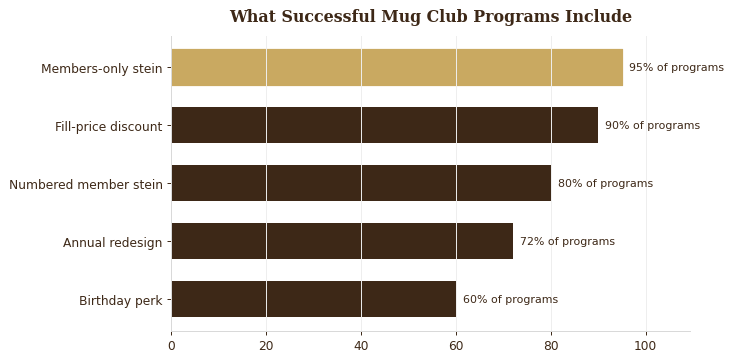
    Elements most common in mug club programs with strong member renewal.
    Elements most common in mug club programs with strong member renewal.

    Planning a numbered, branded stein run

    The table below is a simple structure for a first-year mug club order, scaled by taproom size, with guidance on numbering and personalization.

    Program size Suggested stein Personalization
    Small taproom (under 100 members) Ceramic, hand-numbered Member number + brewery mark
    Established taproom (100–400) Glass or ceramic, batch-numbered Number + logo, annual color
    Multi-location brewery Standardized glass across sites Location code + number

    Order a modest overage above your expected membership so a mid-year sign-up doesn’t wait for a reorder, and lock the numbering scheme before the first batch ships. For engraving and print methods that survive a dishwasher and daily handling, see our companion Engraving Styles for Beer Steins: Deep-Etch vs Laser vs Relief, and browse stein styles across our custom beer steins range, or read our heritage to see how other taprooms have built their programs.

    Handling the operational side of a mug club program

    The stein is the visible part of a mug club, but the back-of-house system is what keeps the program running smoothly once membership grows past a few dozen people. A simple numbered rack or labeled hook system behind the bar lets staff find and return a member’s stein in seconds, which matters during a rush when a slow member lookup creates a line. Some taprooms pair the physical stein number with a point-of-sale note so the discounted fill applies automatically rather than relying on staff memory.

    Renewal logistics deserve as much planning as the initial sign-up. Decide early whether membership expires annually and requires a physical renewal (a new sticker, a redesigned stein, or a fresh number) or runs indefinitely once purchased. An annual model gives you a natural yearly reorder point and a reason to refresh the design, which keeps the wall of steins visually interesting over multiple years rather than static. A lifetime model is simpler to administer but removes that built-in reorder and redesign opportunity.

    Staff training is the detail that’s easiest to skip and most likely to undermine the whole program. A mug club only feels special if every bartender treats it consistently — applying the discount without being asked, restocking the wall neatly, and greeting a regular by their stein rather than making them explain the program each visit. A short training note during onboarding, covering exactly how the program works and why it matters to retention, pays off far more than the stein itself.

    Plan a design refresh cadence

    Many strong mug club programs redesign the stein annually while keeping the core shape and material consistent, giving long-time members a reason to display multiple years side by side. Lock this decision before your first order so year-over-year artwork stays visually cohesive.

    Marketing the program matters as much as designing it, and the taprooms that fill a mug club fastest treat the launch like a real event rather than a quiet menu addition. A dedicated sign-up night with a small perk for founding members, a social post showing the stein wall taking shape, and a short pitch trained staff can deliver at the register all drive faster early sign-ups than simply adding a line item to the menu and hoping regulars notice. Early momentum matters because a visibly filling wall of steins becomes its own marketing — new visitors ask about it, and existing members feel the pull of a growing, visible community they’re already part of.

    Frequently asked questions

    What stein material lasts longest in a mug club program?

    Glass holds up best to daily fills, rinsing, and handling behind a busy bar. Ceramic is a close second and looks more premium; stoneware is the most durable but heaviest and priciest, best for a top membership tier.

    Should mug club steins be numbered?

    Numbering is one of the strongest drivers of renewal we see — it gives each member a specific, recognizable spot on the wall and a small sense of status that a generic cup doesn’t provide.

    Building a mug club program?

    Tell us your member count and we’ll design your stein for engraving, or contact us.
    Design Your Stein

  • Custom Steins as Brewery & Taproom Merch

    Custom Steins as Brewery & Taproom Merch

    Custom Steins as Brewery & Taproom Merch

    Walk into most taprooms and the merch shelf looks the same: t-shirts, hats, stickers, maybe a shaker pint with a logo screen-printed on the side. It sells, but it does not stand out β€” and it rarely earns a second glance from a regular who already owns the shirt. If you are rethinking your brewery merch lineup for the coming year, engraved steins deserve a serious look. They carry higher margins than apparel, they photograph beautifully behind the bar, and they turn your best customers into walking (and pouring) advertisements at every backyard gathering they host.

    This guide covers why steins outperform typical taproom merchandise, how to price them, what branded steins cost at wholesale quantities, and how breweries use them to anchor mug clubs and anniversary releases.

    Why Steins Outperform the Usual Merch Shelf

    Brewery merch works when it does two jobs at once: it makes money at the register, and it markets the brewery after it leaves the building. Most apparel does the second job well and the first job poorly β€” sizing inventory ties up cash, and margins get squeezed by blanks, printing, and markdowns on odd sizes. Glassware flips that equation. There are no sizes to stock, no seasonal designs to clear out, and the perceived value of an engraved stein is far higher than its unit cost.

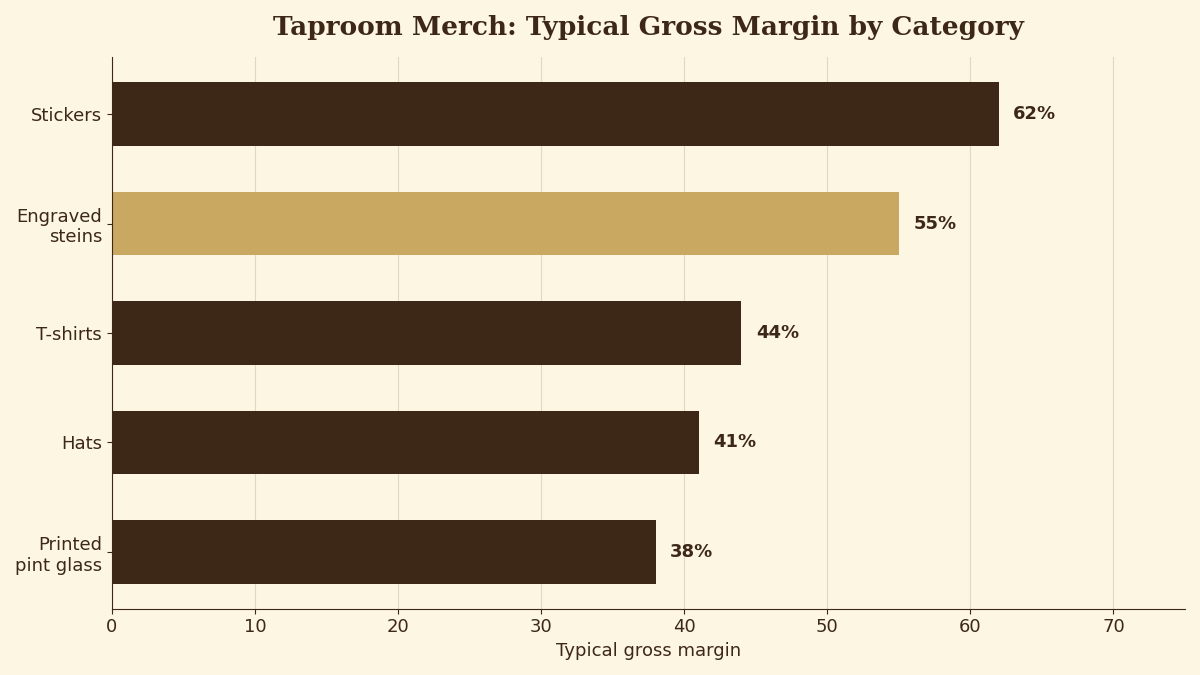
    Bar chart comparing typical taproom merchandise gross margins, with engraved steins leading t-shirts, hats, glassware, and stickers
    Typical taproom gross margins by merch category. Engraved steins combine sticker-level margins with apparel-level price points.

    There is also the shelf-presence argument. A wall of branded steins above the back bar is dΓ©cor, inventory, and a sales pitch at the same time. Customers ask about them. Nobody asks about the t-shirt folded in a cubby.

    Four Ways Breweries Put Branded Steins to Work

    1. Core Merch Shelf Item

    The simplest play: a half-liter glass stein with your logo deep-etched, retailing at $28–$35. Because engraving is permanent (unlike printed pints that fade in the dishwasher), customers treat it as a keepsake rather than a cup β€” which justifies the price point.

    2. Mug Club Membership Vessels

    Mug clubs are retention engines, and the vessel is the product. A numbered, name-engraved stein that lives on a shelf in the taproom gives members a reason to come back weekly β€” their mug is literally waiting for them. Breweries typically bundle the stein into a $75–$150 annual membership alongside pour discounts and early access to releases.

    3. Anniversary & Limited Releases

    A numbered run of 100 steins for your fifth anniversary sells out in a way another t-shirt drop never will. Scarcity plus permanence is a powerful combination: limited engraved runs routinely support $40–$55 price points, especially when paired with a special release pour.

    4. Events, Festivals & Oktoberfest

    Festival pours taste better in real steinware, and attendees keep the glass β€” meaning your logo goes home with every ticket. Many taprooms build the stein cost into a festival ticket and treat it as marketing spend that customers pay for.

    Wholesale Pricing: What Branded Steins Cost

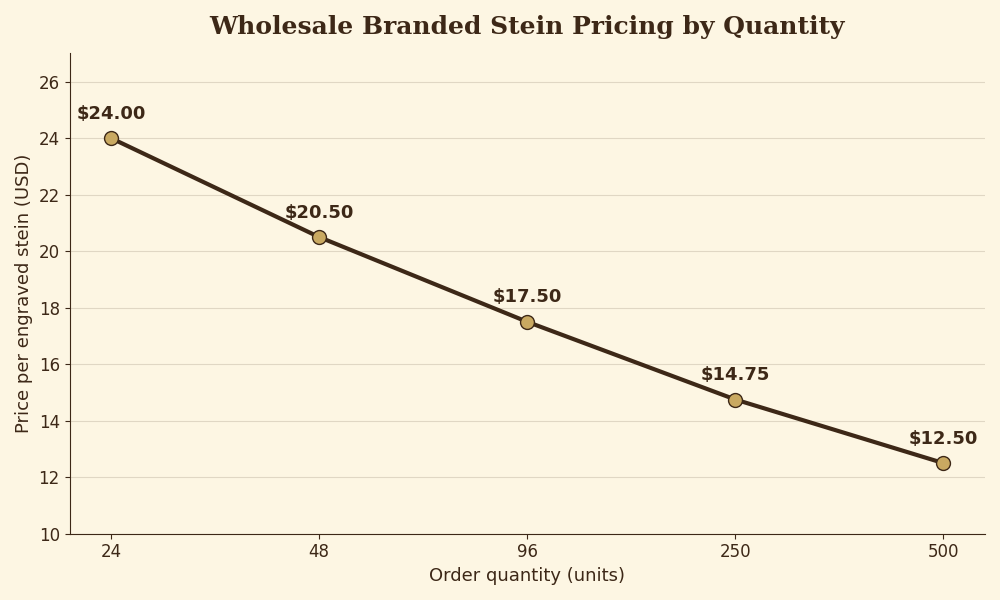
    Like most custom drinkware, engraved steins price on a quantity curve. The setup work β€” digitizing your logo, calibrating the engraving β€” is fixed, so per-unit cost falls quickly as order size grows.

    Line chart showing wholesale branded stein price per unit falling as order quantity increases from 24 to 500 units
    Typical wholesale per-unit pricing for logo-engraved half-liter glass steins. The 96–250 range is the sweet spot for most taprooms.

    Here is how the math tends to work out at retail for a mid-sized taproom:

    Order quantity Typical unit cost Suggested retail Gross margin per stein
    24 units$24.00$34.00$10.00 (29%)
    96 units$17.50$32.00$14.50 (45%)
    250 units$14.75$32.00$17.25 (54%)
    500 units$12.50$30.00$17.50 (58%)
    Taproom tip: Do not order your first run at the deepest discount tier. Start at 12 units, confirm which design and size actually moves at your register for eight weeks, then commit to the 250–500 tier on the proven winner. The margin you give up on round one is cheap insurance against 400 steins of the wrong design.

    Design Guidelines That Keep Engraving Sharp

    Engraving is not printing, and designs need small adjustments to look their best etched into glass or ceramic:

    • Go single-color in concept. Engraving renders your mark as frosted line work, so logos that depend on color gradients should be simplified to a strong outline version.
    • Mind minimum line weights. Very fine details under roughly half a millimeter can fill in. Bold, confident marks engrave best.
    • Use the real estate. A stein offers a far taller canvas than a pint glass β€” stacked lockups with the brewery name, founding year, and city read beautifully.
    • Number limited runs. “14/100” engraved near the base costs little and meaningfully increases perceived value.

    Any reputable supplier will send a digital proof and, for larger runs, a photographed pre-production sample before committing the full quantity.

    Merch That Builds Regulars, Not Just Revenue

    The best brewery merchandise deepens the relationship between the customer and the taproom, and steinware is uniquely good at that. A mug club member with a numbered stein on your shelf has a standing reason to return. A festival-goer with your anniversary stein in their kitchen cabinet re-encounters your brand every weekend. That compounding visibility is what most brewery merch never achieves β€” and it is why glassware, done well, outlasts every apparel trend.

    Steins also cross over into gifting: plenty of taproom regulars buy a second engraved stein as a birthday present. If that is a market you want to serve at the register, our milestone and birthday stein gift guide shows what individual buyers look for in a personalized piece.

    To see engraving styles and past brewery projects, browse the blog or learn more about our process on the about page. The full catalog covers glass, ceramic, and lidded styles in every standard taproom size.

    Put your logo on merch that never hits the clearance rack.

    Wholesale pricing on logo-engraved steins for taprooms, mug clubs, and festivals.

    Design Your Stein
  • Oktoberfest Beer Steins: Sizes, Styles & How to Choose the Right One

    Oktoberfest Beer Steins: Sizes, Styles & How to Choose the Right One

    Oktoberfest Beer Steins: Sizes, Styles & How to Choose the Right One

    Few objects say “Prost!” like an Oktoberfest beer stein raised in a Munich beer tent. But if you are buying one — for a themed party, a brewery promotion, or a collection — the choices add up fast: ceramic or glass, lidded or open, half-liter or the full one-liter Maß. This guide breaks down Oktoberfest beer stein sizes and styles so you can pick the right vessel for the occasion and order with confidence.

    An authentic Oktoberfest beer stein is more than a mug. The size signals the setting, the material shapes the experience, and the decoration carries the tradition. Here is everything that matters before you buy.

    Oktoberfest beer stein sizes

    Munich runs on the Maß — the one-liter pour. But steins come in a ladder of sizes, and the right one depends on whether you are toasting, serving, or displaying.

    SizeVolumeTypical use
    0.3 L~10 ozTasting, lighter pours
    0.5 L~17 ozStandard serving stein
    1.0 L (Maß)~34 ozThe classic Oktoberfest pour
    2.0 L+~68 ozShowpiece & novelty steins
    Hosting tip: for a party, half-liter (0.5 L) steins keep beer colder and are easier to lift through a long toast; reserve the full Maß for the centerpiece pour.

    Materials and styles

    CeramicTraditional, keeps beer cold, the iconic German look
    GlassShows the beer, pairs with pewter or printed crests
    Pewter-liddedThe hinged lid — heritage centerpiece of any set

    Why the lid?

    That hinged pewter lid is not just decoration. Historically it dates to plague-era sanitation laws that required covered drinking vessels to keep insects out. Today it is the signature flourish of a heritage Oktoberfest beer stein — and a great surface for an engraved crest or year.

    Ceramic vs glass

    Ceramic (the classic gray-and-blue salt-glaze) keeps beer colder longer and delivers the most authentic look. Glass steins show off a golden Märzen and take engraving and full-color crests beautifully. Many collectors keep both.

    Choosing for your occasion

    Match the stein to the setting and the decision gets easy.

    Themed home party0.5 L glass or ceramic
    Brewery / taproom promo0.5 L logo glass
    Centerpiece toast1.0 L Maß
    Collector / giftPewter-lidded ceramic

    Personalizing an Oktoberfest beer stein

    An engraved name, year, or club crest turns a seasonal mug into a keepsake. Breweries put their logo on half-liter glass steins for sale and staff gifts; hosts add the party year; collectors add a crest to the lid. Laser engraving suits names and logos, while sandblast etching gives crests depth.

    Buying in bulk for an event or brewery? Order four to six weeks ahead — lidded ceramic and custom-engraved runs have longer lead times than plain glass.

    Care so it lasts

    Hand-wash an Oktoberfest beer stein rather than running it through the dishwasher, especially anything with a pewter lid or hand-painted detail. Dry it upright, and store lidded steins with the lid slightly open so the hinge and interior stay fresh. Treated well, a good stein outlives the party by decades.

    Pick your size by setting, your material by taste, and add a personal engraving if it is a gift or a keepsake — and your Oktoberfest beer stein will earn its place at every toast to come.

    Want a stein that’s truly yours?
    Design Your Stein

    More reading: visit our about page, browse the blog, or learn how to personalize a beer stein.

  • Beer Stein Materials Guide: Stoneware vs Glass vs Pewter

    Beer Stein Materials Guide: Stoneware vs Glass vs Pewter

    Choosing a custom beer stein starts with the material, because stoneware, glass, and pewter each drink, age, and engrave differently. The right choice depends on whether you want old-world heritage, a clear view of the pour, or a heirloom-grade presentation piece. This guide walks through the three classic stein materials so your finished gift looks and feels exactly right.

    Material is the first decision and the one that colors everything after it, from the engraving method to the price to how the stein will be used once it leaves the box.

    The Classic Three Materials

    Stoneware is the traditional heart of the German beer stein: heavy, opaque, and made for relief artwork. Glass shows off the beer and pairs beautifully with etched designs. Pewter is the premium, ornate option, often reserved for presentation and display. Each has a clear best use.

    MaterialCharacterBest engravingBest for
    StonewareHeavy, heritage, opaqueRelief castingTraditional gifts
    GlassClear, shows the pourLaser / etchDaily use, weddings
    PewterOrnate, premiumHand engravingDisplay, milestones

    Pick the material first; it guides the engraving and the occasion.

    Stoneware: The Heritage Standard

    If the picture in your head is a classic Bavarian stein with a hinged lid and a raised scene, that is stoneware. It is thick, keeps beer cool, and is the natural home for relief designs and traditional motifs. For heritage gifts, beer-hall aesthetics, and anyone who wants the most recognizable stein silhouette, stoneware is the default for good reason.

    Glass: Show the Pour

    Glass steins are the most versatile for daily use and large events. They let drinkers see the beer, they take crisp etched or laser designs cleanly, and they suit weddings and restaurants where a modern look matters. A glass custom beer stein is the easygoing all-rounder: lighter, more affordable in quantity, and endlessly personalizable.

    Pewter: The Presentation Piece

    Pewter is where steins become heirlooms. Ornate, substantial, and often paired with hand engraving, a pewter stein is built to be displayed and handed down. It carries the highest price and the most prestige, making it ideal for retirements, major milestones, and awards meant to sit on a shelf as much as on a table.

    Matching Material to the Moment

    For a traditional gift with that unmistakable stein look, choose stoneware. For weddings, daily drinking, or larger consistent orders, glass wins. For a once-in-a-career milestone meant to be admired, pewter delivers. Decide the material first and every other choice, from engraving to budget, falls neatly into place.

    Design Your Stein

    Found your material? CustomBeerStein crafts personalized steins in stoneware, glass, and pewter, engraved to suit the occasion. Learn more about us, read the blog, or design your stein today.

    Ready to personalize it? See our engraving techniques guide: laser vs hand-etched vs relief.