Pick up a European beer mug and look just below the rim and you will often find a small etched line, a number like 0.5 L, a stamped logo or two, and sometimes a tiny official-looking mark. Most buyers read the number and ignore the rest. But those markings are a compact language about how much beer the glass really holds and whether that volume is guaranteed, and understanding them makes you a sharper buyer of custom steins, especially if you plan to engrave one. Here is what each mark means and where it matters when you order.
The fill line, and why it sits below the rim
The most important mark is the fill line: a horizontal etched line that shows the volume the glass holds when filled to that point, not to the brim. It exists because a fair pour needs room for foam. Fill to the line and you get the stated volume of liquid with the head forming above it, which is exactly why the line is set a deliberate distance down from the rim. On a large German glass that headroom is meaningful, on the order of an inch and a half of space above the line, so a mug marked 0.5 L will actually hold noticeably more if you fill it all the way up. That gap is not the maker shorting you; it is the difference between a measured serving and a brim-full glass.
Where fill lines are legally required, the line itself has to meet real specifications. In Germany the line must be horizontal and at least 10 millimeters long, positioned at the required distance from the rim, and paired with a manufacturer identifier so the glass is traceable. Those little stamped codes near the line, abbreviations like Rastal, Sahm, or short tags such as Bö and Kö, are the glassmakers signing their work, not decoration.
Reading the capacity number: metric to ounces
European steins are marked in liters and fractions of a liter, which throws off buyers used to US ounces. The common serving sizes are 0.3, 0.4, and 0.5 liters, with the one-liter Maß being the iconic Oktoberfest pour, and the ladder extends both smaller and much larger. The conversions are worth committing to memory because they are exact: one liter is 33.8 US fluid ounces, so a 0.5 L stein is 16.9 ounces to the line, a 0.4 L is about 13.5, and a 0.3 L is roughly 10.1. A full liter Maß at 33.8 ounces is more than two American pints, which is why it feels enormous in the hand.
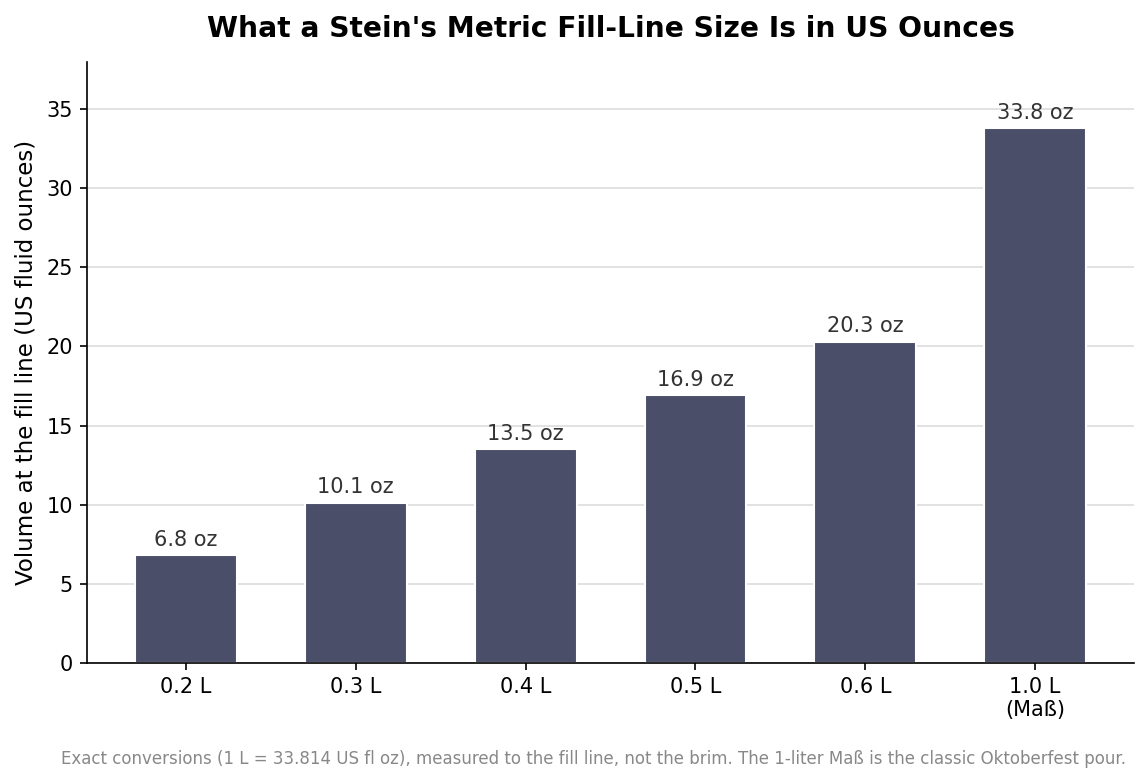
Keep in mind those figures are the volume to the fill line. Because the glass is built with foam headroom, the same 0.5 L stein filled to the very top holds more than 16.9 ounces, so if you are matching a stein to a specific pour, buy by the marked fill-line capacity rather than by how tall or wide the vessel looks.
What the official marks actually certify
Beyond the maker’s stamp, glasses intended for commercial service in Europe can carry conformity marking tied to measuring-instrument rules. The EU harmonized its approach under the Measuring Instruments Directive, with a transition that ended on October 30, 2016, after which drinkware sold for measured service in the EU and Switzerland has to comply. The practical promise behind those marks is accuracy: a certified serving glass has to deliver close to its stated volume within a defined tolerance. Austria’s serving-vessel rules, for example, allow only about 5 percent deviation on small glasses in the 10-to-50-milliliter range and tighten to roughly 3 percent on larger ones, and the UK’s pint convention expects a pint to be at least 95 percent liquid, leaving no more than a 5 percent head. Those are consumer-protection numbers; they exist so a bar cannot quietly serve you short measures.
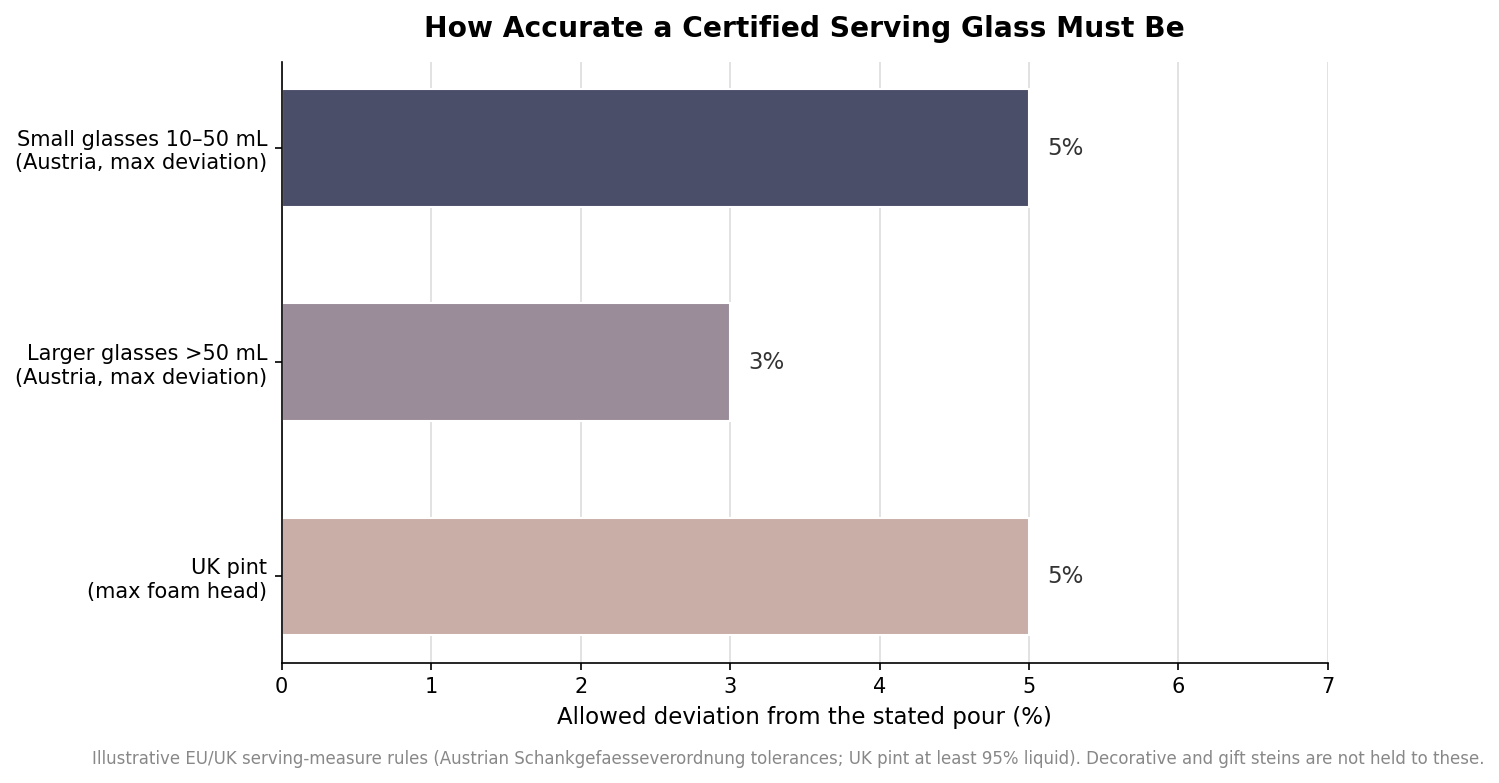
The nuance that matters for gift buyers is that these rules govern glasses sold to pour measured drinks, typically clear glass serving mugs. A decorative stoneware or ceramic stein bought as a gift or a shelf piece usually states a nominal capacity without carrying legal calibration, and that is completely normal. If you specifically want a calibrated, fill-lined glass, look for the line and the marks; if you want a traditional lidded ceramic stein for a mantel, the stated size is a description, not a certified measure, and you are not missing anything by its absence.
Why this changes how you specify a custom stein
Once you can read the marks, three ordering decisions get easier. First, choose capacity by the fill line, not the silhouette. A tall narrow 0.4 L and a squat wide 0.5 L can look similar on a product page, so the marked number is your real guide to the pour your recipients get. Second, protect the marks in your artwork. On a calibrated glass, the fill line and maker’s stamp are functional and often legally required, so your engraving or print should be placed to sit clear of them rather than running an image straight through the line. Give your decorator the wrap dimensions and note where the line sits so the layout is designed around it.
Third, match the format to the use. For a brewery serving measured pours, a fill-lined glass mug signals honesty and fits the regulatory expectation. For milestone gifts, wedding favors, and mantel pieces, a beautiful ceramic or stoneware stein with a clearly stated capacity is the right call, and it frees the whole surface for your design. Either way, the small marks near the rim stop being mysterious once you know that the line is the honest pour, the number is liters not ounces, and the stamps are the makers and, sometimes, the regulators vouching for it.