The lead question comes up whenever someone plans to actually drink from a custom stein rather than shelve it, and it is worth answering precisely because the honest answer depends on which part of the stein you mean. A beer stein is really two materials in contact with your beer: the ceramic, stoneware, or glass body you drink from, and, on lidded models, the pewter lid and trim your lip may brush. Modern steins from a reputable custom supplier clear the safety bar on both counts. The genuine caution belongs to antiques, flea-market finds, and unregulated imports, and lumping those in with a new engraved stein is where most of the worry comes from.
Why a stein faces the strictest lead limit
Anything designed to hold a beverage you drink is regulated more tightly than a plate, because liquid sits against the surface and because acidic drinks pull metals out of glaze faster than dry food does. The FDA sets leachable-lead action levels for ceramicware in its Compliance Policy Guide 545.450, and the limits tighten as the vessel gets more drink-like. Flatware is allowed up to 3.0 micrograms of leachable lead per milliliter; small and large hollowware step down to 2.0 and 1.0; and cups and mugs, the category a stein falls into, sit at the tightest 0.5 micrograms per milliliter, tied with pitchers. The chart makes the hierarchy plain.
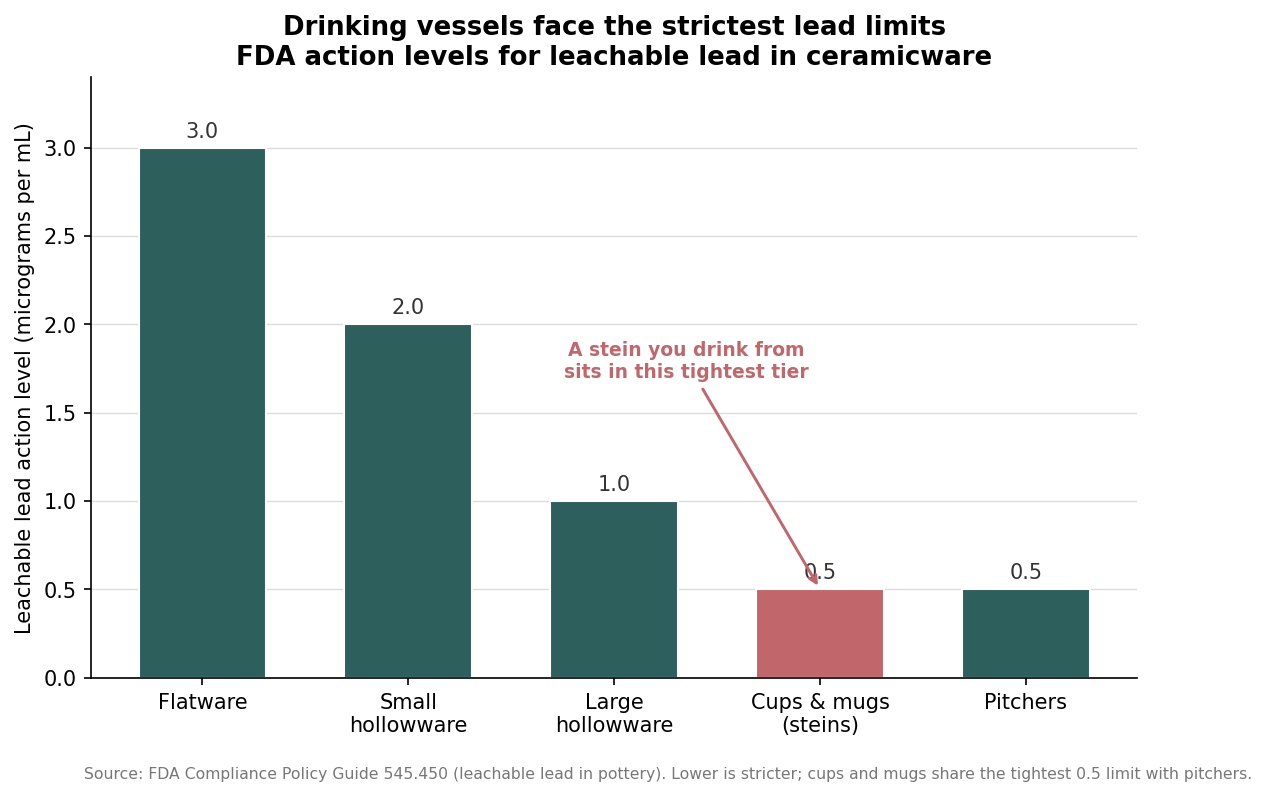
A stein lives in that bottom tier. A 0.5-liter or 1-liter mug with a handle is, in regulatory terms, a cup or mug, so it must meet the strictest leachable-lead standard on the board before it can be sold for drinking in the United States. Some states go further; California’s Proposition 65 sets exposure thresholds well below the federal action level, which is why serious manufacturers test to the stricter of the two. The takeaway for a buyer is that a new stein sold as drinkware has already had to pass the hardest version of this test, and a display-only or antique piece has not.
The ceramic body: where lead can hide, and why new steins are clear
In a fired ceramic or stoneware stein, the metal that matters is not in the clay but potentially in the glaze, the glassy coating that gives the surface its color and sheen. Historically, some glazes and decorative enamels used lead compounds to lower firing temperature and brighten color, and if such a glaze is under-fired or worn, small amounts can leach, especially when acidic liquid sits in the vessel. That is the real mechanism behind lead-in-dishware stories. The modern reality is that reputable production glazes are formulated lead-free, and any stein sold as drinkware in the U.S. has to satisfy the 0.5 limit above. Glass steins sidestep the question entirely, since soda-lime glass carries no leachable lead glaze in the first place.
Where caution is warranted is outside that regulated lane. An antique stein of unknown vintage, a hand-glazed souvenir bought abroad, or a decorative piece never intended for drinking may carry a legacy glaze, and none of them has been leach-tested to a modern standard. The practical rule is simple: drink from new steins made and sold as drinkware, and treat unmarked vintage or purely decorative pieces as shelf display. If you do use an older stein, avoid storing acidic liquids in it for long periods, which is exactly the condition that accelerates any leaching.
The pewter lid and trim
Lidded steins are the ones that raise the pewter question, because the lid, thumb-lift, and any pewter rim can brush the lips. Here the history is stark and the modern answer is reassuring. Traditional pewter was an alloy of tin with as much as forty percent lead, which made old tankards heavier and quick to tarnish, and it is the reason genuine antiques deserve caution. Modern pewter is engineered without lead: a typical casting pewter runs about 94 percent tin with roughly 5 percent antimony and 1 percent copper for hardness, and lead-containing pewter is simply no longer used for anything that touches food, drink, or skin. The contrast is easiest to see side by side.
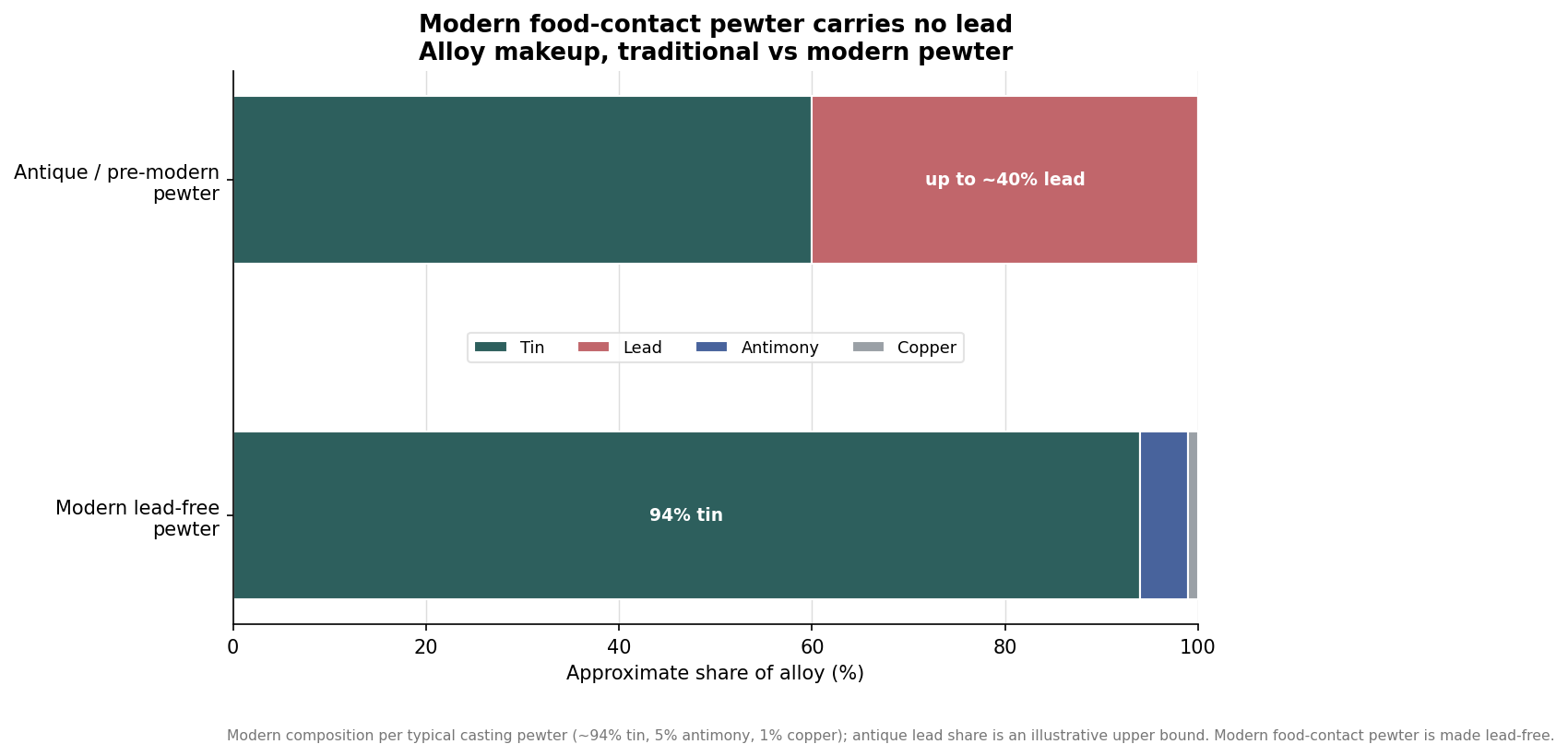
So a modern lidded stein with a pewter lid is safe to drink from, while a genuine antique pewter tankard of unknown alloy is the piece to admire rather than use. Care matters more for looks than safety on modern pewter: it tarnishes over time, dislikes the dishwasher’s heat and detergents, and prefers hand washing with mild soap and a soft cloth. None of that is a toxicity issue; it is about keeping the finish bright and the engraving crisp.
What to confirm before you order
Turning this into a buying checklist keeps it concrete. Ask the supplier to confirm the stein is sold as food-safe drinkware with a lead-free glaze, not as a decorative-only item, since that single distinction separates a leach-tested product from an untested one. On lidded models, ask that the pewter be lead-free, which is standard for reputable modern pewter but worth stating. If you sell into California or ship nationally, ask whether the pieces are evaluated against Proposition 65 as well as the federal action level. And steer any vintage or unbranded-import steins toward display rather than drinking, because those are the pieces the standards above were written to catch. A supplier who can answer these plainly is telling you the product sits inside the regulated lane rather than outside it.
For most custom orders the answer lands in the same place. New engraved steins in glass, ceramic, or stoneware, with modern lead-free pewter lids where fitted, are safe to drink from and are built to meet the strictest lead standard applied to drinkware. Common capacities run 0.3, 0.5, and 1.0 liter, custom engraved runs frequently start around 24 to 48 pieces, and lead times of roughly two to four weeks after art approval are typical, though those figures are indicative and vary by supplier and decoration method. Buy new steins to drink from and reserve the flea-market treasures for the shelf, and the lead question resolves cleanly.