A logo that looks sharp on a business card or a pint-glass label does not automatically translate to the curved wall of a stoneware stein. Engraving removes or alters material in a single tone; it does not lay down ink. That one fact changes how you should prepare the file, and getting it right before you approve a proof is the difference between a crisp brewery mark and a muddy shape no one can read across a taproom. This walkthrough covers what to send, how small your finest details can safely be, and how to lay art out for a round surface.
Engraving is one color and one depth — design for that first
Contrast on a stein comes from the material, not from ink. On clear glass the engraved area frosts to a pale, translucent white; on dark stoneware or a glazed ceramic body the cut reveals a lighter tone beneath the surface; laser marking on some coated finishes produces a crisp darker mark. In every case you get one tone against the background, so a logo that leans on a red-on-black relationship, a drop shadow, or a soft gradient has to be rethought as a single silhouette. Convert your mark to one color before you send it and look at it in pure black on white: if it still reads, it will likely engrave well. A representative engraver is blunt about this, noting that multi-color artwork “will be converted to one color, which can lead to undesired results,” and that layered art ends up appearing as a single layer. Decide which layer carries the identity and build around it.
Send vector art when you can, clean raster when you can’t
Vector files are the ideal. Formats such as AI, SVG, EPS, PDF, and DXF scale to any stein size without losing edge quality, and their paths map directly to the engraving tool path. Keep shapes as closed paths and convert text to outlines so a missing font can’t reflow your layout on the shop’s computer. If all you have is a raster logo, send the highest resolution available; a common minimum is at least 1,200 pixels on the longer side. A small image pulled from a website — often only 300 pixels wide — will look pixelated once it is scaled to fill the engraving window, and no amount of shop skill recovers detail that was never in the file. If your only mark is low resolution, budget for a redraw: many shops offer art conversion for a fee (at one representative vendor, conversion starts around $20 with a separate logo setup fee near $10), and that is far cheaper than re-running a batch that came out soft.
Know the smallest detail that will survive
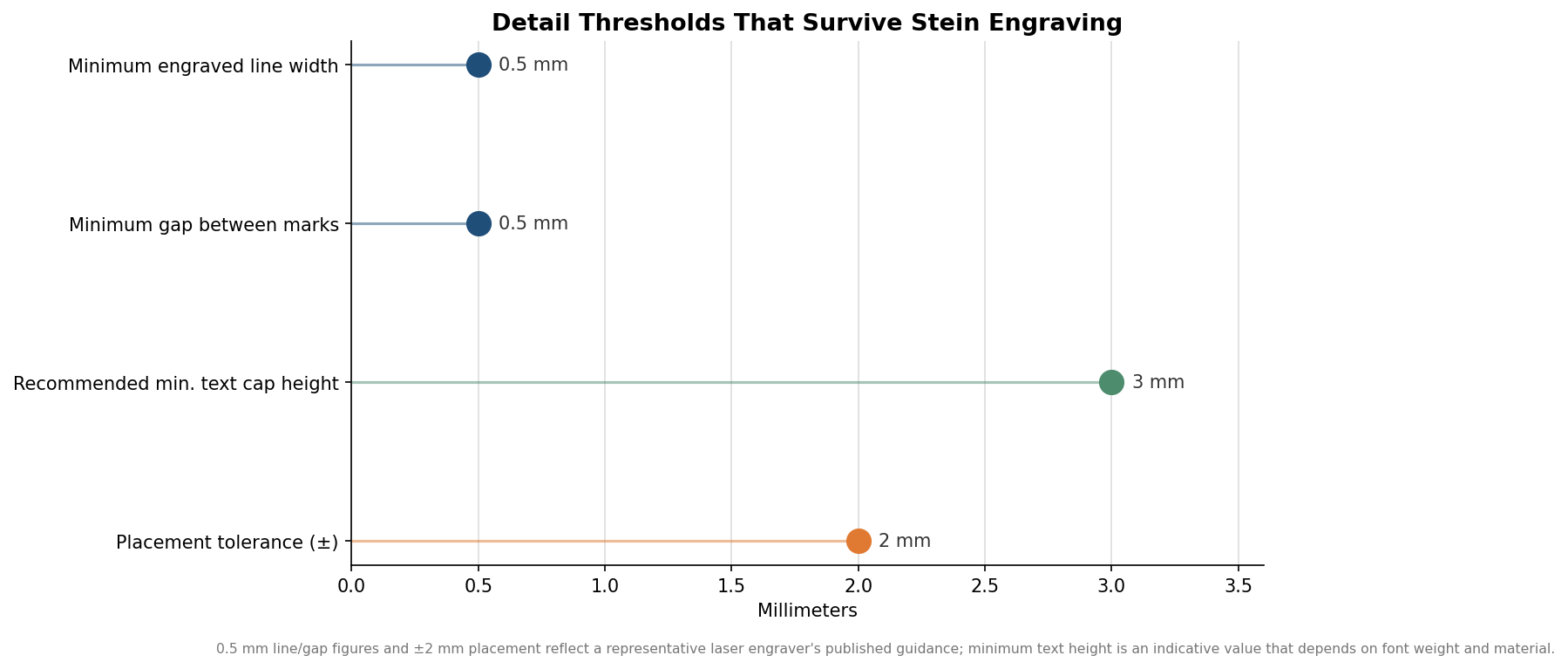
This is where good art most often goes wrong. Engraving has physical limits: very thin lines and tiny gaps break down because the beam or bit cannot hold a feature narrower than its own working width, and on fired ceramic or glass a fragile sliver of engraved material can chip away. A representative laser engraver publishes a minimum white space of about 0.5 mm between engraved areas and warns that “thin lines between the engraved areas can be brittle and break off easily.” As a working rule, keep strokes — and the gaps between them — at roughly 0.5 mm or wider at final size, and keep text cap heights near 3 mm or taller. Small legal lines, ® and ™ marks, full web addresses, and hairline monograms are the usual casualties. If your logo carries a fine tagline, consider dropping it or setting it larger on its own line. The chart here shows the thresholds worth checking against before you approve anything; treat the 0.5 mm figures as a representative floor rather than an exact universal spec, since the true limit shifts with the material and the machine.
Lay it out for a curved surface, not a flat page
A stein wall is round and often tapered, so you are designing into a limited window rather than onto an open canvas. Logo engraving areas are frequently capped around 6 square inches — roughly a 2.5-inch square, or about 3 inches wide by 2 inches tall — though larger 0.5-liter and 1-liter bodies can often take art on more than one side or position. Art is typically scaled to fill about 80 percent of the available area, so build in a little breathing room and keep detail away from the extreme edges, where the curve falls off from the tool. Expect a placement tolerance on the order of ±2 mm; that is invisible on a bold, centered crest but very noticeable if you try to align a mark precisely with the handle or a molded seam. Center-weighted marks that are roughly square or circular handle the curvature best, while very wide horizontal logos wrap around the barrel and can distort or run past the flat engraving zone.
Approve a proof, and build the timeline backward from your date
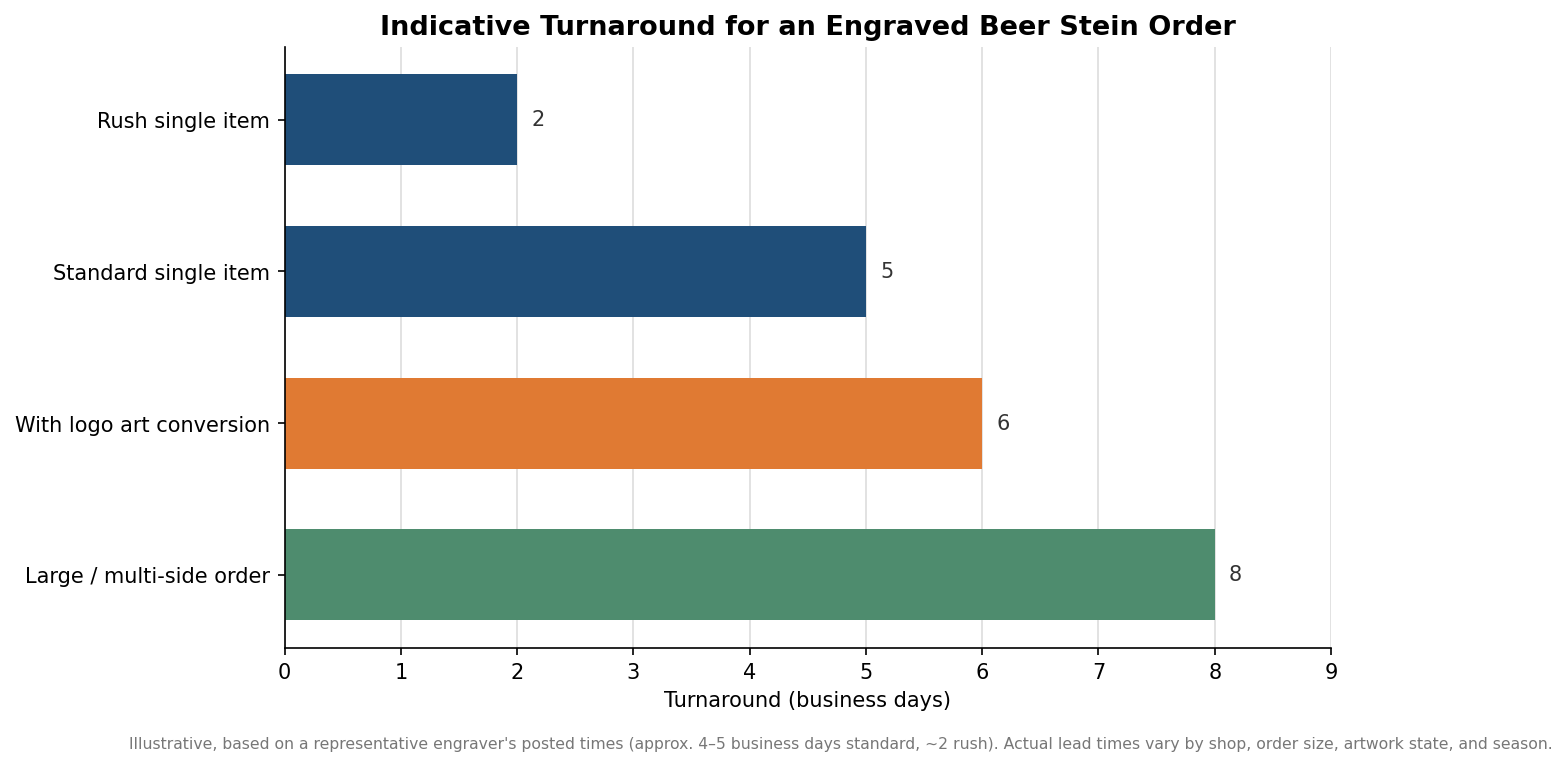
Before production, ask for a proof — a digital layout, or for larger orders a single engraved sample — and check it at arm’s length, the way a guest will actually see it, not zoomed in on a screen. Confirm the spelling, the single-tone silhouette, and that the smallest text still reads. Because engraved sales are typically final and cannot be un-cut, that proof is your last real checkpoint. On timing, a representative shop quotes roughly four to five business days for standard engraving and about two for rush service, with art conversion and multi-side or large orders adding time; the turnaround chart above maps those paths. If you are ordering for a wedding, an anniversary, a corporate service milestone, or an Oktoberfest event, work backward from the date and add a buffer for a proof round and shipping. A clean vector file, a single-tone design, details kept above the size thresholds, and a layout built for a round wall will move through that timeline with the fewest surprises — and leave you with a stein worth keeping on the shelf.