Stein, mug, tankard, Krug, Seidel: the words get used as if they were interchangeable, and in casual English they nearly are. But each one originally named a specific vessel with its own material, size, and features. When you are buying one to engrave, the name is not trivia, because it quietly determines what surface you are decorating, whether there is a lid, and how much beer the finished piece holds. Knowing which is which keeps you from ordering a pewter-lidded showpiece when you wanted a plain glass mug, or the reverse.
Where the word stein actually comes from
“Stein” is an American shorthand. It is clipped from the German Steinzeug, meaning stoneware, and the fuller old term Steinzeugkrug, a stoneware jug. In Germany itself the everyday word for a beer mug is simply Krug, and nobody walks into a beer hall asking for a stein. So when an American catalog says “stein,” it usually means the ornate, often lidded stoneware or ceramic mug that Americans associate with Bavaria, whether or not that is what a German would call it. That gap in the vocabulary is the root of most of the confusion that follows.
Mug, Seidel, and Krug: the everyday vessels
The plainest term is mug: a cylindrical, handled vessel, usually thick glass or ceramic, with no lid. The handle is not decoration; it lets you hold the vessel without warming the beer with your hand. In German-speaking pubs the same everyday mug is a Seidel, and it comes in two standard pours, 0.3 liters and 0.5 liters, which are the sizes you are actually served at a table. The half-liter, at just under 17 ounces, is the workhorse, a touch larger than a US pint and the size most people picture when they think “a beer.”
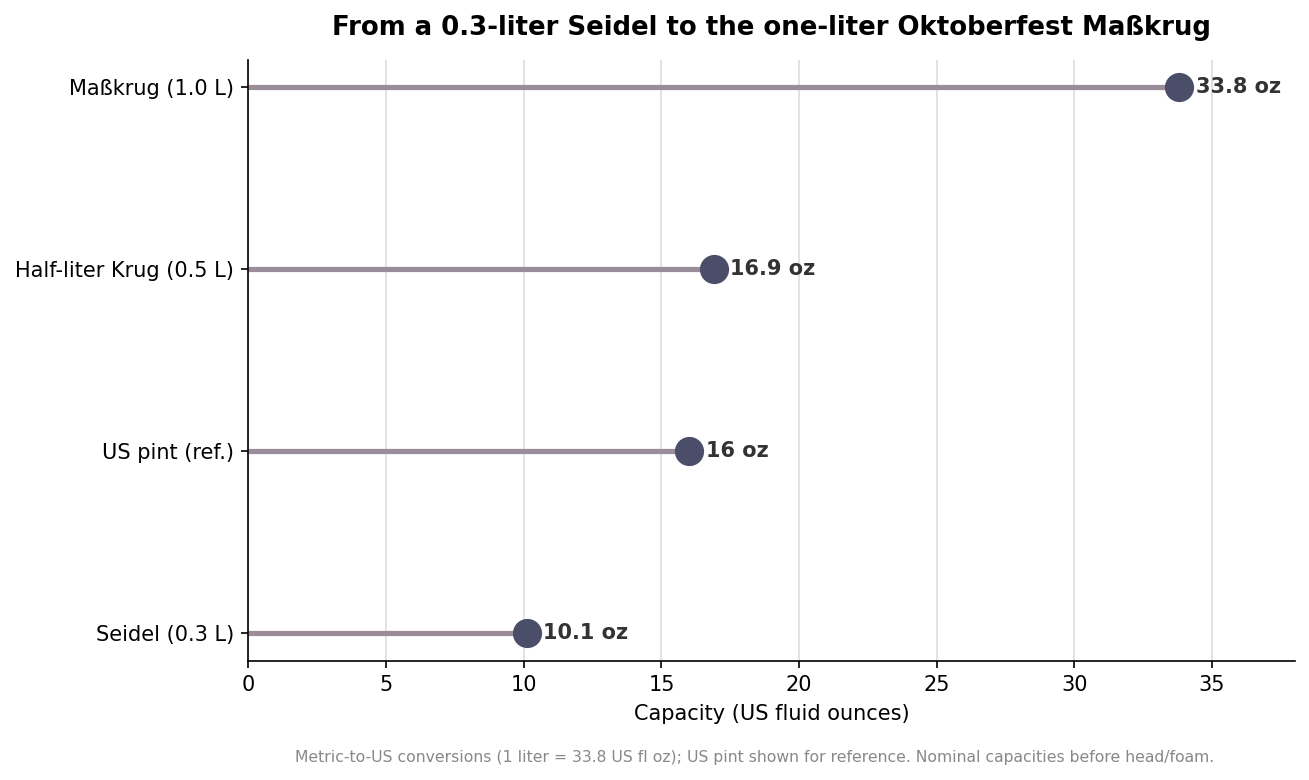
The tankard and its metal lineage
A tankard is defined by its material, not its shape. Historically it was metal, traditionally pewter or silver, a single-walled cup that came out of England and Europe. Some tankards had flat hinged lids, but the metal is the point. That lineage matters for a gift, because a modern engraved pewter tankard reads as heirloom and formal in a way a glass mug does not, and it takes engraving as a soft, hand-tooled line rather than the frosted look you get on glass. If someone asks for a “tankard,” they are usually picturing metal.
Why the lid exists
The hinged lid is the feature people most associate with the classic stein, and the story most often told traces it to public health. In the wake of the Black Death, German sanitation practice pushed drinkers to keep food and drink covered against flies, and the beer mug answered with a hinged pewter lid worked by a thumb-lever so you could flip it open and drink one-handed. Historians debate the details, but the practical design is real: a lid keeps the pour covered, and the thumb-lever is genuinely convenient. On a custom piece today the lid is mostly about tradition and presence, and it also gives you a second surface, the lid itself, that can be engraved or cast in relief.
Which name to order when you are customizing
Translate the vocabulary into a buying decision by starting from material, because material drives both the look and the engraving. Glass mugs take a clean, frosted laser mark and read modern and everyday. Stoneware and ceramic steins suit deep-etch and relief work and can carry color, which is why they make the ornate collectible pieces. Pewter tankards and pewter-lidded steins are engraved or embossed and lean formal and traditional. Then choose size for the occasion: the 0.5-liter is the most versatile gift and the easiest to actually drink from, while the one-liter Maßkrug is an Oktoberfest and display piece with real presence but real heft. It helps to know what a liter really is before you commit, because “one liter” sounds modest until you see it next to a bottle.
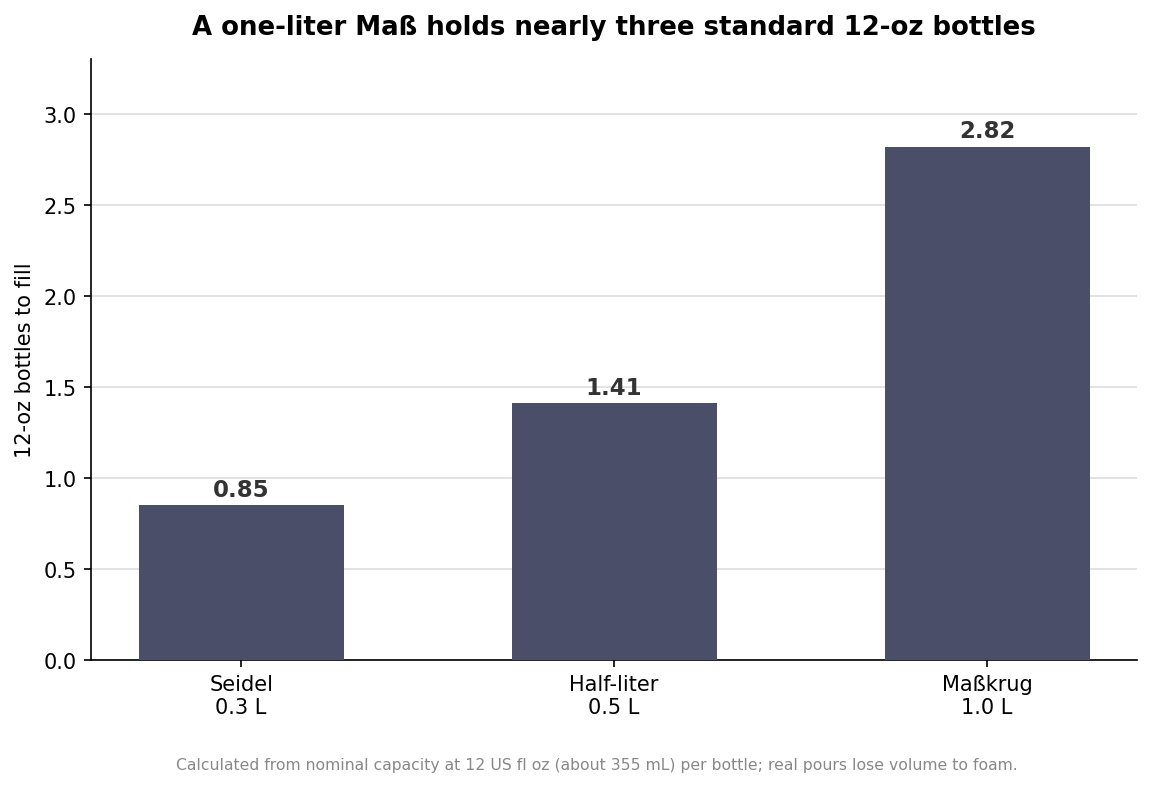
A one-liter Maß holds nearly three standard 12-ounce bottles, which is a lot of beer to lift repeatedly and a big reason the half-liter is the more practical everyday and gifting size. Order the liter for impact and tradition, the half-liter for something a person will actually reach for on a weeknight.
The vessel also decides how much personalization actually fits. Most engraving sits on the front panel, opposite the handle, so the usable area is whatever that face gives you. A broad stoneware stein offers room for a full crest, a monogram, and a couple of lines of text; a slim glass mug is better suited to a name and a short date than a paragraph; and a lidded piece adds a small medallion area on the lid itself for a date or a single initial. Sketch the words and artwork against the specific vessel before ordering, because a design that looks balanced on a wide ceramic panel can wrap awkwardly around a narrow glass one.
None of this is about being pedantic with a bartender. It is about ordering the right object. Decide whether you want stoneware, glass, or pewter; whether a lid belongs on it; and which pour size fits the moment, and the name mostly sorts itself out. Get those three calls right and the engraving goes onto exactly the vessel you had in mind, instead of a near-miss you settle for because the words all sounded the same.